The Butcher Shop

Saturday, September 30, 2006

Another funny Fred Hembeck cartoon about Superman's Kryptonian parents.
posted by Matt Butcher @ 7:14 PM   0 comments
This week in life...
This was a long but good week.

Varsity volleyball is in full swing. I like how things are going. Interesting to note that some of the JV players came up to me this week, saying they missed me, and wishing that the JV coach made them do as many push ups as I made them do! They actually said that to me! One week from today, the Varsity and I will fly to Kotzebue to play, just above the Arctic Circle. I've flown to Kotzebue two or three times now, but never gotten off the plane as we waited on the tarmac to proceed to Nome. I'll finally set foot in Kotzebue.

Also, classes have been proceeding wonderfully. Amazingly, I haven't had any real discipline problems. I have only a handful of students that won't turn in their essays (that we worked on in class for a week, but I digress). With the sophomores, we just finished The Giver, a novel by Lois Lowry that I absolutely love. Love it so much now that I added up how many times I've read it, alone and in class to students now, a total of nine times. And it still gets me. With the seniors, we started our Shakespeare unit, focusing on Hamlet first. I am having a great time with the performance-based teaching of the play. I am only having a bad time getting the frickin TV to play the video with audio at the same time in my room. I like to show them a scene after we do the scene in class. We don't watch the movie straight through. I show them the Kenneth Branagh version, mostly.

Morgan and Madison and Amy are great. Busy but great. Morgan seems so...adult now. We went to the pool today, and Morgan helped out with Madison in the women's locker room, getting her ready. Madison is a daredevil and had a ton of fun in the pool.

Other than that, things are going great. We have a bake sale tomorrow at the AC for the Varsity team. We have to raise at least $300 more. I hope I'm not there all day. This is really my last weekend until volleyball is over. Games every weekend.
posted by Matt Butcher @ 2:02 AM   0 comments
Pointing out transcendentalism is tough
After a little research, find a working definition of “transcendentalism” that you are comfortable with using in this discussion. Do the same for “naturalism,” but be careful not to confuse Whitman’s sense of naturalism with the sense of “naturalism that developed towards the end of his life in the American novel (Dreiser, Norris). They are quite different.
In what ways does Whitman identify with nature? Section 24 of the Deathbed Edition of Leaves of Grass details many of Whitman’s views on natural and the natural man and woman. What are they? This section, as you have learned, caused some problems with prudish censors at the time, especially his comment that “copulation is no more rank to me than death.” Were Whitman’s praises of death and sexuality unusual in his time? How do these views fit in with natural and transcendental views? In what sense does Whitman say that he is “divine”? How does Section 32 (“I think I could turn and live with animals”) fit into this world view.
Throughout Leaves of Grass there are innumerable passages that reflect Whitman’s philosophy of nature and the self. In what passages do you find these views most prominent and well-expressed? In many ways, Whitman is trying to “express the ineffable,” that is, give words to what cannot be put in words. What does this mean? Where in Leaves of Grass do you find him attempting to express the “mystery” of life and perhaps failing—although the failure is magnificent? Is this ineffability what he is referring to in the last three lines of Section 52? Here they are:
• Failing to fetch me at first keep encouraged,
• Missing me one place search another,
• I stop somewhere waiting for you.

Pointing out transcendentalism is tough to newcomers because it is a new way of thinking. Try to tell someone to think of a higher spiritual power without giving it the name of a god. I like to think Emerson’s one vision of the transparent eyeball holds much in this respect:
I become a transparent eyeball;
I am nothing;
I see all;
the currents of the Universal being circulate through me;
I am part or parcel of God.

And Emerson also said, “To create—to create—is proof of a divine presence.”

I like the following definition of transcendentalism to give meat to the fact that they believed in something, not the dogma that organized religion provided: William Henry Channing(1810-1844)
"Transcendentalism, as viewed by its disciples, was a pilgrimage from the idolatrous world of creeds and rituals to the temple of the Living God in the soul. It was a putting to silence of tradition and formulas, that the Sacred Oracle might be heard through intuitions of the single-eyed and pure-hearted. Amidst materialists, zealots, and skeptics, the Transcendentalist believed in perpetual inspiration, the miraculous power of will, and a birthright to universal good. He sought to hold communion face to face with the unnameable Spirit of his spirit, and gave himself up to the embrace of nature's perfect joy, as a babe seeks the breast of a mother."

In this regard, naturalism comes out as a way to identify humanity’s place in a post-Darwinian world. I, myself, have this contradiction and have always liked the transcendentalists. I want to believe in the power of the spirit but see the Kansas song lyric, “All we are is dust in the wind,” just as true. How do you combine the two philosophies? Whitman tried to exemplify this with thinking that copulation was just another natural act, as death was. Years later, Freud would expand these theories. I remember getting in trouble in high school talking about Freud’s view of sex, basically anything pleasurable not necessarily copulation, in vulgar terms. It is not vulgar, but a simple drive. But in those days, the era of Victorian England, people would cover up the table legs to prevent uncouth thoughts. I think along these lines for simple bathroom functions—no one talks about them but we all do them, and shouldn’t we as a human race have been past this nastiness? The answer is no because we are natural creatures. So when Whitman praises these basest of the human frailties, he was seemed as a bit deviant. We want to think we have surpassed these things, but we simply cannot escape these basest of natural functions.

In the poem “As I Ebb’d with the Ocean of Life,” Whitman tries to talk about the fact that he may not be as divine as he would have liked to think. He wanted his poetry to be this great manifestation of the ideal, of everything that he idealized. He realizes that it isn’t, at times, the work of a man looking back on it and creating true poetry out of the junk. He thinks that some of it is junk, yet still creates poetry out of it, because the junk is part of the everything that he is idealizing. “But that before all my arrogant poems the real Me stands yet untouch'd, untold, altogether unreached... / ...I have not really understood any thing, not a single object, and...no man ever can." He thinks he “can turn and live with animals” because we ARE animals. In a way, he realizes that what he is creating is ineffable and can’t put words to it. He has great ideas, but expressing such a concept is hard. Look at the fact that there are numerous definitions of exactly what a transcendentalist is. He tries to create it, does his best, but in the end, all it is is himself standing there, planting the seeds of thoughts that maybe someone greater can help him with.
posted by Matt Butcher @ 1:53 AM   0 comments
Thursday, September 28, 2006

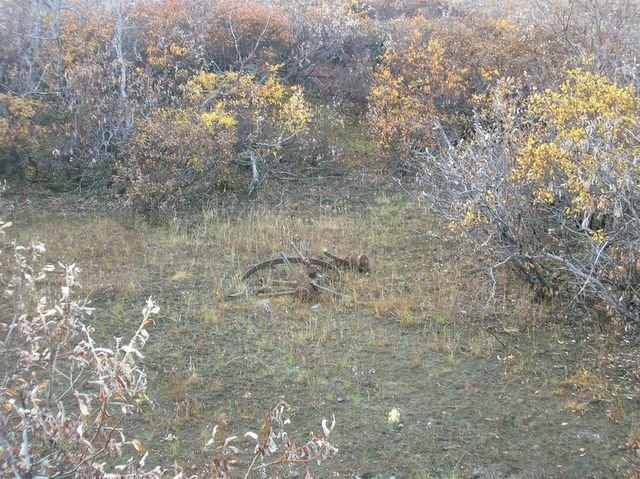
This implement or device or whatever it once was now rusts by the side of the gravelly path. I just keep thinking who didn't put their tools away! Think about what some scientist is going to say about this after he digs it up a thousand years from now.
posted by Matt Butcher @ 8:36 PM   0 comments

This is another stream I had to cross on the way home.
posted by Matt Butcher @ 8:33 PM   0 comments

Here's a random bone or antler (I have no idea) in amongst a blueberry patch.
posted by Matt Butcher @ 8:31 PM   0 comments

I find the Alaskan sky to be so much bigger somehow. Maybe it is the lack of trees or the horizon that touches the sky.
posted by Matt Butcher @ 8:26 PM   0 comments

A little Alaskan stream nearby.
posted by Matt Butcher @ 8:25 PM   0 comments

I love this picture for some reason.
posted by Matt Butcher @ 8:23 PM   0 comments

Metal tools and things just left in the middle of what appears to be nowhere. Fascinating.
posted by Matt Butcher @ 8:20 PM   0 comments

See, I find it amazing and bewildering that they didn't even take the metal implements. I could understand if the wooden structure was left, but the metal had to be valuable.
posted by Matt Butcher @ 8:18 PM   0 comments

Like this old pump house. Somebody built it. Somebody used it. Now it stands in disrepair and decay.
posted by Matt Butcher @ 8:15 PM   0 comments

I wonder how things such as these pipes, once apparently needed by somebody for some type of job, now rot out here on the tundra.
posted by Matt Butcher @ 8:14 PM   0 comments

On my walk the other day, I found myself fascinated, absolutely fascinated, with some of the refuse and machine implements that have been left to rust away here on the Seward Peninusula. Here's a jeep just left out in the middle of nowhere. Who's was it? What happened to it? How did it get here? This is just one of the little instances where I understand how anthropologists and archaeologists study the remains of people and what they leave behind.
posted by Matt Butcher @ 8:11 PM   0 comments

We saw a rainbow against the sky the other day.
posted by Matt Butcher @ 8:05 PM   0 comments

My new review is up for AdHouse Books' new anthology PROJECT: ROMANCE. It also traces the genre through comic books and shows its influence on modern day fare. Very interesting stuff.
posted by Matt Butcher @ 7:50 PM   0 comments
Wednesday, September 27, 2006

An old Fred Hembeck strip from an old DC Comic.
posted by Matt Butcher @ 8:53 PM   0 comments
Tuesday, September 26, 2006

I don't know what to make of the new NBC show called HEROES yet. The pilot was lackluster and slowly paced. I like the concept alone and believe that this would be the way that superheroes, or humans simply with extraordinary abilities, would come upon us. There would be no flashy red capes and glittering spandex. They would be the everyman, and some would not believe in their own newfound powers and indeed get freaked out by them. The problem with HEROES, as this reviewer from The Washington Post points out, is that "NBC's derring-doers come in with a whimper." This is the kind of show that I want to succeed, that I want to see, yet it bored even me at times. One of the curses of superhero comic book readers is that we've seen it all before. I hope this show picks up fast, a lot faster than last season's ABC sci-fi epic called INVASION that had such promise but bored me to tears because it never moved forward. If HEROES is slow, as this reviewer says for the first three episodes, no one is going to stick around.
posted by Matt Butcher @ 8:01 AM   0 comments
Eskimo Heritage Reader part 13
A Flood at Sand-Spit

This happened in the Fall of 1913. I was just a kid then. My family was in Nome, camping at sand-spit. There were Wales people and King Island people camped there, too. They came to Nome to buy their winter groceries. Everyone lived in tents down on sand-spit.

A storm began to blow in October. It kept on blowing for days. On the third day, the water began to rise. Waves were washing over the sand-spit, right into the Snake River. Finally the water rose over the top.
Some white people from Nome came to help the natives. There were houses up on high ground. The owners had gone Outside for the winter. Those white people broke the locks on the doors so the natives could take shelter in the houses. My family and my uncle moved into one of those houses.

At the end of the sand-spit, where the jetty is now, was a large NC store. A great big building! It had groceries and a cold storage--winter supplies for the people of Nome. That night, after we all moved, the flood rose over the sand-spit. It broke up that big store and washed everything into the Snake River.

That same night, after we moved into the house, my sister had a daughter. Lilly's older sister Maude was born. It was October 13th in the evening.

The flood washed away all the houses from the sand-spit. The only ones left were half-buried under sand. The blacksmith's house was broken up, all except the machinery. In the morning, houses were floating in the river. At daybreak, they saw a man floating on top of his house.

All the supplies from Lomen Cold Storage had washed into the river. All the winter meat supplies. Everyone was hooking up quarters of beef, sheep, and hams, crates of chicken, and barrel after barrel of butter. Whatever we found, we could keep!

My dad and my uncle and my brother-in-law took a boat. They got out in the river and hooked up the beef and lamb, all that cold storage meat. It was good! The river was clean and cold. Everyone had a lot of free meat and butter after the flood.

My uncle went upriver. At the high-water mark, he found a little tin box. He opened it. It was full of money! Instead he asked who it belonged to. Some white man claimed it was his. Maybe it was, maybe it wasn't. My uncle just gave it to him.

--Jerry Kaloke of Nome
posted by Matt Butcher @ 7:30 AM   0 comments
Monday, September 25, 2006

I'll tell you why no one went to see the "Sean Penn remake" of All the King's Men...It's a remake! I think most moviegoers are sick of remakes. We want something new. Jackass sounds like all the kids in America went to go see it. Why would adults go see these remakes and stuff when they can watch them on DVD in three months?
posted by Matt Butcher @ 8:35 AM   0 comments
Sunday, September 24, 2006

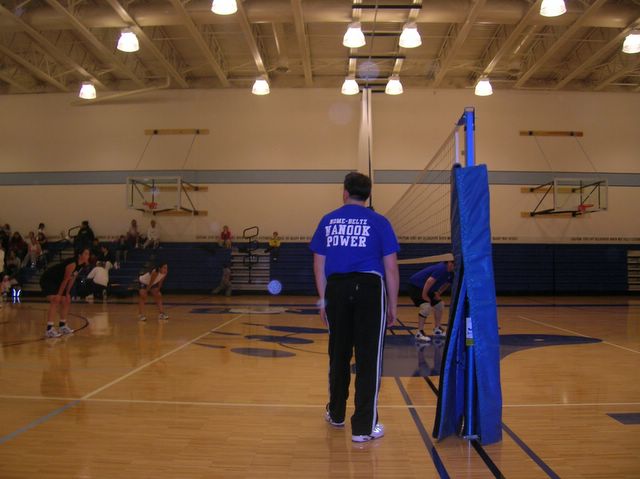
Mr. Welch and Ms. Schaffer go for a ball as I watch on. We got our tails kicked.
posted by Matt Butcher @ 5:47 PM   0 comments

Yesterday was our little Queen of the Court volleyball tournament. We had seven teams all together, three girl teams, two faculty teams, and two community teams, which was very nice. We didn't make all that I had hoped but it was fun. We might have another one then later next month, maybe during alumni weekend.
posted by Matt Butcher @ 5:46 PM   0 comments

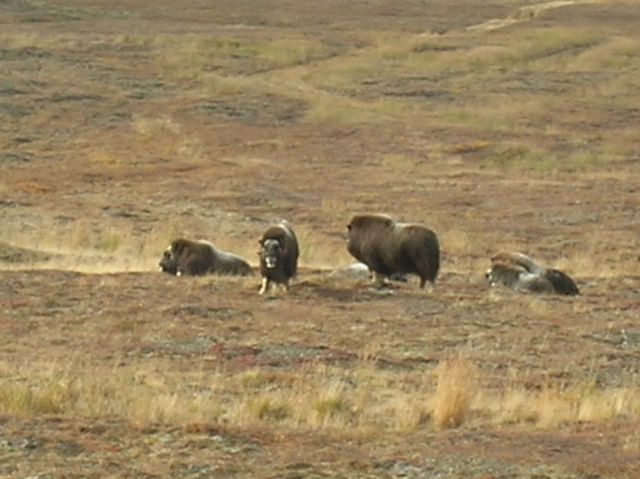
These musk ox were just napping away, most of them. It's amazing to see them wild and up close, but not too close!
posted by Matt Butcher @ 5:43 PM   0 comments

Right over the mountain was a herd of about 15 musk ox taking a nap.
posted by Matt Butcher @ 5:42 PM   0 comments

See...I touched the rock.
posted by Matt Butcher @ 5:41 PM   0 comments

I went out for a hike today. Nome power was shut off for a couple hours, scheduled, as they worked on it. And right in the middle of the only Chicago Bears game I'd probably get to see this year! There's this inuksuk, rock formation, that we see out our window all the time and I realized that I have never touched it. So I decided to do it today.
posted by Matt Butcher @ 5:39 PM   0 comments
Eskimo Heritage Reader part 16
Nuuk Fish Camp

In the years before the white men came, before any Christianity, many people lived at Safety Lagoon. They had no metal tools. Their hunting spears and arrowheads were made of jade and flintstone. Their pots were made from wood stumps. Their main purpose was survival. To govern all these people, there were leaders and shamans and tribal laws. The laws were often harsh, and there was no appeal.

Now in those times it was forbidden to cook a fowl or mammal from the sea along with a fowl or mammal from the land. This meant a woman could not cook a seal with a rabbit. She could not cook walrus with bear, or murre with ptarmigan, or land bear with polar bear.

In those days, women cooked their meat in wooden pots. They put hot stones into the pot along with meat and water. They took a hot stone from the fire and dropped it into the pot. The water would boil. The meat would cook as the stone cooled. Then they took that stone out and dropped in another hot one. They continued until the meat was cooked. It was a lot of work cooking for many people!

Once two women cooked a ptarmigan along with an eider duck. Perhaps neither one knew what kind of bird the other brought. A ptarmigan is from the land and an eider is from the sea. It was forbidden to cook them together. They put both birds into a cooking pot. When the stones were very hot, they took one and dropped it into the pot. What happened next was a terrible disaster.

Between Cape Nome and Safety Lagoon was a flat area occupied by the tribes. That whole flat tipped over. The people and everything that had been on top were buried. The bedrock became the land mass. The west wind blew and made a new beach. Even now when a strong west wind blows, the breakers east of Cape Nome carry a fine white powder from that bedrock. It blows like foam over the beach and dries on the road in white streaks.

That's not the only place where this happened. There is another spot near Shishmaref and another near Point Hope. Here, too, the law of the Eskimo was broken. Here the land tipped over on the people. When the first white men came to Point Hope, they were told of an upside down place there. They did not believe it until some anthropologists came. Those "diggers of old things" were amazed. They found pots and pans, people and everything, all upside down. Just like someone turned over a sheet of paper.

The fish camp at Nuuk was established after that earlier tribe was turned upside down. There was a large qazig. The door was made from the shoulder bone of a whale. Every fall, the surrounding tribes would gather there for a celebration.
posted by Matt Butcher @ 10:15 AM   0 comments
Saturday, September 23, 2006

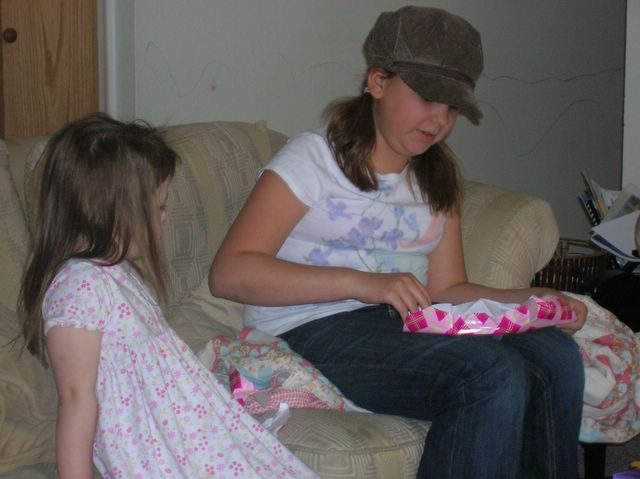
Madison even wrapped herself up as a present yesterday!
posted by Matt Butcher @ 12:51 PM   0 comments

Madison was having just as much fun opening birthday presents as Morgan was yesterday!
posted by Matt Butcher @ 12:50 PM   0 comments

Another shot of a great sunrise. Sunrise happened today about 8:45 or so!
posted by Matt Butcher @ 12:43 PM   0 comments

The sunrise over Nome on this chilly September morning. We have the little three-on-three volleyball Queen of the Court tournament today at the gym to raise some money for our trip to Ninilchik next month.
posted by Matt Butcher @ 12:38 PM   0 comments

Morgan turns 12 today. Unbelievable. She's so grown up already.
posted by Matt Butcher @ 12:40 AM   0 comments
Thursday, September 21, 2006
Volleyball Varsity Posted
The hardest part to being the coach is making cuts.

After working for three solid nights of practice, I was able to determine who the twelve girls to keep on Varsity were. It is such a hard decision. Usually, the first ten are pretty easy to pick out. When you reach that eleventh, twelfth, thirteenth, fourteenth area, they can almost blur together. However, there is always something that separates them somehow.

So I posted the list on my classroom door at 3:00 pm sharp, the second school got out. Boy, was there a throng of girls gathered down that corridor at that time! Since 38 girls showed up for tryouts on those three nights, I think they were all just about down the corridor at that time.

I am confident with my selections though. And I am so excited to be working so much closer to Varsity this year with our practice being in the morning and JV being in the afternoon. I will really make a good coaching connection with them.
posted by Matt Butcher @ 8:21 PM   0 comments
Tuesday, September 19, 2006

Another comic review! This one is of THE MIDDLEMAN VOLUME 2 by Viper Comics. Only at Independent Propaganda.
posted by Matt Butcher @ 9:50 AM   0 comments

Abandoned Tolkien novel to be finished by son Christopher. He compiled most of the unfinished works before into little paperbacks that gather together much of Tolkien's work, but it will be nice to read a new NOVEL set in Middle Earth. As long as it is not written like THE SILMARILLION and is written more like a true narrative like THE LORD OF THE RINGS, everything will be great.
posted by Matt Butcher @ 9:42 AM   0 comments
Eskimo Heritage Reader part 15
Eskimo Heritage Reader 15

Legends and Stories from Shishmaref

The Dancing Skeleton

Once when my father was a child, some Wales people came to Shishmaref. They came to dance, but also to fight. My father was told to stay home that evening. He should not follow the men or watch the dancing. But the children went outside to play anyway.
It was a calm and windless night. Across the lagoon from Shishmaref, the dancing music could be heard. There were graves near the tents, near where the children were playing. As they wrestled on the ground, they looked up at the graves. On top of one grave sat a skeleton. Then the dancing beat started up. The skeleton began to move to the beat, following the drum by moving its neck. Back and forth it moved its head to the beat.
My father saw this and said it was so.


A Battle Story

My father told me that our people did not always get along with Igloo people. They fought each other for as long as anyone could remember. One time a man from Shishmaref was hunting inland. He noticed some strangers coming towards the village. They looked like warriors, coming to fight. He ran to warn his people. The Shishmaref men gathered up their arrows and spears and went out to meet the Igloo men.
They met on the hill east of Ear Mountain. Without saying a word, they began to fight. The men from Shishmaref shot the Igloo men with arrows and lances, shot them even in their hearts. But the Igloo men did not die. Then, by accident, one of them was pinned on the toe. Right away, this Igloo man died. In this way, it was discovered that the Igloo warriors, with the help of their shamans, had relocated their hearts into their toes!


Mermaid Stories

The elders speak of mermaids, seen long ago. Sometimes a hunter, out in the ocean, would see a mermaid with long, long hair, sitting on an ice flow. There were mermen, too, with short hair and headbands of bleached sealskin.
Maybe in the fall, a hunter might catch a mermaid in his seal-net. Then he could ask for something, something delicious like beluga. Whatever he asked for, he could have. Other hunters would check their nets and butcher the seal they had. If a seal had only one kidney, they believed that was really a mermaid.
Once a young man was hunting seal on the spring ice. He saw a seal and began to stalk it. Slowly, he crept across the ice. But, when he took aim with his rifle, he saw that this one was part human. It was a mermaid! Quickly, the hunter backed away. He turned and began to run. The hunter was fast, but the mermaid soon caught up with him. Just as the mermaid reached the hunter, he turned his rifle backwards and shot it.
When he returned to the village, he told the people how he had shot a mermaid out on the ice. A group of men decided to go out and retrieve the body. There had been no wind that day. But suddenly a strong wind blew from the south and broke the ice away from shore. Maybe, they said, those mermaids have some kind of magical power.
So our ancestors did not bother the mermaids and today no one ever speaks about them.

by Morris Kiyutelluk of Shishmaref
posted by Matt Butcher @ 12:27 AM   0 comments

My review for Silent Devil's LIL' HELLIONS: A DAY AT THE ZOO is up at Independent Propaganda. A fun little book.
posted by Matt Butcher @ 12:18 AM   0 comments

My review of the Viper Comic called VILLAINS is up at Independent Propaganda. Check it out! It's a pretty cool tale that chases the villain as the protagonist of our story. What really makes a villain?
posted by Matt Butcher @ 12:14 AM   0 comments
Monday, September 18, 2006
Feed

I just finished the most fantastically written and thought-provoking book I have read in a long while.

Feed by M.T. Anderson

First of all, I love dystopian/utopian fiction. The “feed” is the internet, world wide web, in your head. All the time. Banner ads flashing when something happens to you. Specific market targeting. The kids don’t even read any more because they have the feed give them everything straight into their brains. Everything is digested for them, and all that people really strive for is the pleasure. Even trips to the moon or Mars is only just okay, as if everything is boring, as we adults see the kids think stuff is boring nowadays.

The author did a tremendous job of making this book sound like a teenager from the near future. New slang terms and whole paragraph-long run-on sentences make the narrator seem like the average kid that we teach in high school, where instant message spellings and instant thoughts seem the norm. Even my writing this has just been supremely influenced by this book. The English grammarian in me was fascinated by how the book was written, sentence by sentence, new term by term. I kept thinking how Hemingway might perceive this writing.

This book will go right up there with some of my favorites now, like 1984, Brave New World, The Giver. This book updates all those concepts into the 21st century. Incorporating the internet in your head in this way is a phenomenal piece of science fiction that just feels too near to us.

"Keep thinking. You can hear our brains rattling inside us, like the littler Russian dolls."

That line above speaks volumes, not just about the theme of the book, but about the theme of life in the 21st century.

I learned a lot reading this novel. It sparked me.
posted by Matt Butcher @ 12:54 AM   2 comments
Sunday, September 17, 2006
Nanook Volleyball
Nanook volleyball

Volleyball starts up Monday night. I am excited and nervous and apprehensive again, all rolled into one. However, I will tell you that I am more ready this year than last year, by far.

Varsity/JV tryouts will be Monday, Tuesday, Wednesday evening from 6-8pm. I am already writing up my plans and scoresheets for those three days. Varsity will be posted Thursday, no practice. Then Friday, JV and Varsity pretty much split up for good this year. Varsity will practice in the mornings from 6-8. JV will practice on the other side of the gym from wrestling practice from 4-6pm. Maybe some get-togethers and scrimmages, but practices will be differentiated by far this year. That’s cool by me because then I will only have to concentrate on the twelve members of Varsity.

Doing something a bit different this year too. Tryouts are definitely going to be scored a little more. I am making up these little spreadsheets to score the players every night. The new JV coach will score with me and we’ll go over the scores together, just to make sure that we both analyze and work with each other’s input. Male JV coach this year and that means I will have to find female chaperones on all the trips, ugh.
posted by Matt Butcher @ 12:13 AM   0 comments
Saturday, September 16, 2006
Phenomonology is the science of the description of appearances, so does film accomplish this?
Matt Butcher

Film class

Phenomonology is the science of the description of appearances, so does film accomplish this? Does film describe appearances or does it appear to describe reality? Bazin’s notion of the “ontology of film images” is the REALITY of film images. I think we need to keep in mind that Bazin wrote in the 1940s and 1950s, keeping in mind that this was long before the current computer-generated era of movies. Film images are either aesthetic or psychological, “the duplication of the world outside.” Total cinema is then a myth to Bazin because what we consider today as film requires technical innovations that were not present 80 years ago or less. The same will be true in the future, as technical innovation arises to meet the needs of directors and the demands of the audiences, movie making will change. I am a fan of the superhero genre and I keep saying how we finally have the technology to do the films properly, especially if you’ve ever compared 2002’s Spider-Man to its 1970s predecessor. Early filmmakers just wanted to recreate the world by combining photograph and phonograph, the new technologies of their day, like computer geeks nowadays do something just to see if it can be done. (In computer infancy, one college hooked up to the Coke vending machine down the hall to see if it was empty before they bothered walking. Little did these computer geeks think past this to the applications this could do now for inventory systems.)

Metteur-en-scene is French for director or filmmaker but it has largely been replaced by relisateur (according to The Film Encyclopedia). Looking at the word relisateur shows the root of realize so it looks like realizer. The actor must “be before expressing himself.”

Kino-pravda tries simply to duplicate real-life as it happens, saying it is giving the ultimate truth. Unfortunately, with Kino-pravda, you are always aware of a film camera in the scene. Metteur-en-scene does better by duplicating life and then filming, forgetting the presence of the camera.

I believe that Kino-pravda can never be true because of the known presence of the camera. It’s like taking home videos and telling your mother to “say something.” There was an experiment once where researchers were studying the effects of light on the productivity of workers. The workers were told that they were being tested, once with extra light, once with no light. The workers worked extremely hard in both circumstances and the researchers realized that telling the workers made them work harder, no matter what circumstances were involved, simply that they were being watched. Kino-pravda is like that.

The Wizard of Oz could never be filmed with a camera this way. It would take away the adventure and the fantasy. I think Kino-pravda still does exist though—as reality TV.
posted by Matt Butcher @ 6:08 PM   0 comments
Eskimo Heritage Reader part 14
Eskimo Heritage Reader 14

Asila, the Trouble-Maker

Long ago on Little Diomede Island, there was a young man named Asila. He was a bad child. He was not respectful. He was not obedient. His parents tried to change him. They scolded him. They warned the other people. But he never changed. When he became a young man, he was still a trouble-maker.
In those days, the shamen gathered together in the spring. They met in the qagri to urge the whales to come to their hunters. They put out all the lights. In the dark, they worked their magic.
All the skinboat owners brought dishes to the qagri. Dishes filled with good food--berries! fish! hmmmm! There was no tea or coffee. There was no white man's food. They put the dishes on the floor near the opening to the qagri. When they put out the lights, that bad one, Asila, would come in and eat!
There was a time in the spring when the shamen met in the qagri. Asila and his friends were playing outside. He said, "Let's go into the qagri. We can go and eat the food. You should see all that good food!" He talked them into going with him.
They came up to the qagri. The tunnel was barred. No one could get through. Asila pulled on the bars, pulled hard. He got one off, then another. The boys slipped into the tunnel. Asila was leading. The others followed. Inside they heard the shamen singing. They waited in the tunnel for the lights to go out.
Inside the qagri, the men took their turns. Each urged the whale to come to the island. Finally, an old blind shaman rose for his turn. He said to the others, "A devil is coming in here." The others cried, "Do something! Try to do something!"
He began to do his magic. He said, "I will work against this devil."
Down in the tunnel the walls started to close in on the boys. The tunnel grew narrower. Now they could only fit sideways. They could not turn around. The walls pushed them into the qagri. They did not want to go, but they were pushed.
Asila was first. He was pushed up, up through the opening into the qagri. He reached the edge, pushed from below. There they slipped something forbidden into his rear end to humiliate him. Suddenly, he dropped. The tunnel grew larger. The boys fell out.
Later, Asila said that it was his idea. He claimed that he had no father to guide him, which was true. In this way, he saved the others from punishment.
After this, Asila was changed. He grew to be a kind and generous man. He became a rich hunter. He had his own skinboat and caught many whales.
One spring day, he was whaling with the other hunters. He came forward in his skinboat and harpooned a whale. The rawhide thong went tight. It snapped around his neck and took his head off. The others watched as his head sank into the water.
They brought him home without a head. It is very sad to have a body without its head.

by Alice Kayouktuk of Little Diomede
posted by Matt Butcher @ 6:06 PM   0 comments

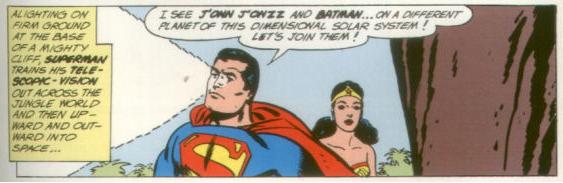
I was reading a copy of a trade that included Justice League of America #1 last night, and I realize why some people don't like Superman comics. This panel is from that 1960s comic. The League has all been banished to another dimension by Despero and Superman uses his telescopic vision to peer across space and sees Martian Manhunter and Batman on another planet. That is just way too powerful, even for me. That even defies my suspension of belief. In the same issue, Green Lantern talks about moving a sun, only he can't do it because it is a 'yellow' sun. Sometimes, I don't understand how these comics lasted past the sixties with these kinds of super feats. If these are really their powers, how can anybody stand up to them?
posted by Matt Butcher @ 1:30 PM   0 comments

Masterpiece Comics linked to my review of their FIREBLAST comic and dropped my name...
posted by Matt Butcher @ 12:05 PM   0 comments

They also have awesome wildlife shots. I actually had a moose meat steak a week ago! It is moose season right now. Some kids even skip school, with their folks, because of it.
posted by Matt Butcher @ 12:00 AM   0 comments
Friday, September 15, 2006

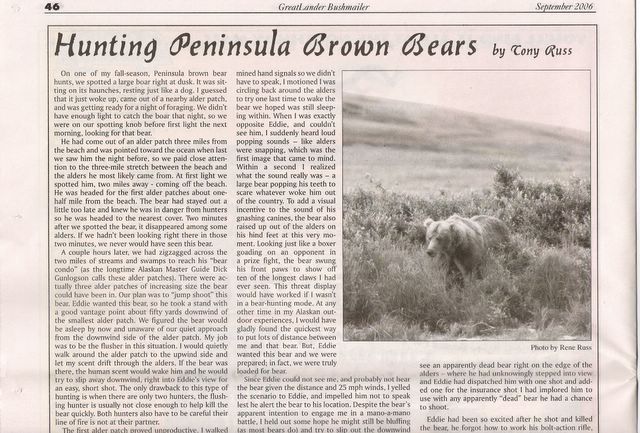
There are even informative articles on hunting bears.
posted by Matt Butcher @ 11:57 PM   0 comments

This is the cover of the BUSHMAILER.
posted by Matt Butcher @ 11:56 PM   0 comments

We get ad pages in the mail too. Little newspapers and flyers. However, our ad pages up here tend to be a little on the wildlife and warmth side. I just wanted to share some of these images that are in these regular old ad pages that come by mail. This is one of a man and his child wearing warm parkas!
posted by Matt Butcher @ 11:55 PM   0 comments
Madison the champ
You are not going to believe this.

My immediate family and I are doing this office football pool thing through CBS Sportsline.com where all you have to do is pick the winners each week. No spread, just heads up.

Madison is winning.

She and I both have ten points on the week, but she was closer in her Monday Night Football total score. Amy and Morgan are not far behind at all at nine points each.

Madison, the three-year-old, who I just read who was playing who, and most of the time, she just shouted out the last team I said, is winning the Butcher Family Office Football Pool.
posted by Matt Butcher @ 3:26 PM   0 comments

The creator of Koni Waves, a comic I reviewed from Arcana Studio, was happy with the review I wrote up on that groovy little comic. Posted in the Arcana Studio forum.
posted by Matt Butcher @ 10:08 AM   0 comments

Deftoons also has my little byline under a quote about their SCHOOL: A GHOST STORY #3. I am loving independent comics.
posted by Matt Butcher @ 9:56 AM   0 comments

HARDBOILEDCOMICS.COM reprinted my review of their own HARD-BOILED COMICS #1 in their forum! They love the fact that I "get" their noir comic!
posted by Matt Butcher @ 9:52 AM   0 comments

My review of SCHOOL: A GHOST STORY # 3 by Brian Defferding is up at Independent Propaganda. Check it out!
posted by Matt Butcher @ 9:47 AM   0 comments
Thursday, September 14, 2006

A review of HOUSE OF SUGAR by Tulip Tree Press is up at Independent Propaganda. I received an advanced copy .pdf to gander at. While this book isn't my cup of tea, it does have a dedicated audience. Read the review.
posted by Matt Butcher @ 9:39 AM   0 comments

Eris, the greek goddess of chaos and strife, is the new official name of that dwarf planet found last year that caused Pluto to lose its full-fledged planetary status. Previously catalogued as 2003 UB 313 and nicknamed Xena, the official name is appropriate given that the planet we know and love as Pluto was then downgraded to dwarf planet as a result of the find and the debate about it.
posted by Matt Butcher @ 9:24 AM   0 comments
Wednesday, September 13, 2006

I made a book. MyPublisher.com is a pretty easy tool. I put together all sorts of locale and wildlife pictures of Nome and our first year here. Not many people shots at all, in fact, I tried to keep people out. It turned out real nice. I even got to write my own text on each page so it seems like a real book. I am quite proud of it. Amy says I am happiest when I am creating something, or doing something creative. She's right.
posted by Matt Butcher @ 7:53 PM   0 comments
Tuesday, September 12, 2006

I joined The Planetary Society this week. I received what would normally be just plain old junk mail, especially when the return address said ARTHUR C. CLARKE, author of 2001, among other things. I didn't just chuck it though. I always got these envelopes as a kid, with their little surveys and explanations as to why space exploration is so important. Even with their recent failure of the solar sail craft, I believe it is necessary to explore. Maybe it is the Star Trek buff in me with the whole "explore new worlds" thing. Maybe it is the fact that I remember getting caught up when my mom made sure to bring me home the newspapers showcasing Voyager sailing past Saturn and Jupiter. E.T. was probably an influence, as well as the countless comics and science fiction stories I read. I always want to think that it is possible, no matter how unlikely. I always returned The Planetary Society's little surveys, expressing my interest but, sadly, not my money. I could barely afford the comic books I was reading and my mom couldn't really fork out the dough. So this time I did, finally. Luckily the introductory rate was $15 and I get a magazine, but the whole point is that I feel better for doing this. I believe that we are at that stage of technological infancy where we are ready to explode into all the scientific realms. I really do. I feel, albeit on a grander scale, what they felt like with computers back in, let's say, the 1940s. They knew what computers would eventually be capable of and look at us now. I feel like it is back in December of 1903 when the Wright brothers took off for those 12 seconds. Imagine the possibilities formulating in their minds and now we have hundreds of planes that cross the continents every day in what seems an infintesimal amount of time compared to sea-travel. I want this to succeed, and if I can only dream with them, well, dreaming with two fantastic minds like Arthur C. Clarke and the late founder Carl Sagan can't be bad company. PLANETARY.ORG
posted by Matt Butcher @ 8:14 PM   0 comments
Monday, September 11, 2006
The Day
I remember waking up, thinking it funny that the news was on the television. Amy and I often fell asleep to tv, usually a channel like TNT or USA because they played those cop shows we would watch until we fell asleep. We must have been watching Jay Leno that night as NBC was now on. That was odd and portentous, to start with, almost as if we were destined to see this first thing in the morning. Without that tv being tuned as it was, living in Washington state, we probably would have gone to work and first heard it on the radio.

I woke up first, as usual, and thought it queer--somebody flew into this Tower in New York. To be honest, I didn't know the Twin Towers from any other building as I have never been to New York. I actually thought that some idiot had flown into it by accident. I remember whispering to Amy this same phrase as she dozed.

As I was getting dressed, watching with that casual disinterest as most news days start, I remember watching the second plane coming in, toward the other tower. With bewilderment, I wondered what was going on, and watched it, live on tv, smash into the second tower. That woke me up.

I didn't know what to think. I couldn't comprehend what was actually happening. I left for work...I had to. I was still in mortgages at the time, still at Puget Sound Mortgage and Escrow in Port Orchard, but I went into the Poulsbo office that day for a processor's meeting. The tv was on at work and I walked in as the building collapsed, so I saw that live on tv as well.

It seemed so far away at the time. Everything shut down so mortgages were pretty much done for the day. I still had some work to do, and I drove to Port Orchard.

I remember the oddest thing about the whole situation that I felt while driving home is that there were no planes in the air. I couldn't overcome that. For the first time in almost 98 years, there were no planes flying overhead, all the time. Couldn't fathom that.

All my other reactions came later, when the news had had time to process and digest information. I was saddened and proud at the same time for the members of the NY Fire Department who bounded up those steps, only to never come back down. I honestly thought that was one of the worst and proudest moments you could ever combine. So it was hard to feel anything specific about the day.

I do remember thinking that the shit had really hit the fan on a worldwide scale.
posted by Matt Butcher @ 3:33 PM   0 comments

My review of School: A Ghost Story #3 by Brian Defferding is up at Independent Propaganda.
posted by Matt Butcher @ 9:37 AM   0 comments
Sunday, September 10, 2006
The Panel is REAL

From May of 1966, the panel I posted earlier is REAL, albeit clipped a bit, most probably from the site http://www.superdickery.com/seduction/1.html You can also download the comic, Justice League of America #44, in .cbr format for viewing from http://www.aibq.com/jla_1.php
posted by Matt Butcher @ 1:49 AM   0 comments
How to Review
I developed a keen insight here on reviewing the independent comics and web comics that I do. I think it is important to look deeply into someone's creativity and explore why a piece was made. I found some diamonds in the rough that I otherwise would skip after first impression. This allows me to give a benefit of the doubt that some people tend to forget.

This information is from the Mark R. Kelly blog at
http://locusmag.blogspot.com/ and he took a lot of it from Vonnegut.

This post is first to recommend the blog Critical Mass, "the blog of the national book critics circle board of directors", i.e. those behind the annual National Book Critics Circle awards, one of those literary awards on par with the National Book Awards and the Pulitzer Prizes for fiction. It's interesting to read a blog from literary enthusiasts outside any particular genre, in this case from a professional/critical perspective (contrasting the reader/fan perspective of Bookslut), and yet who do notice genre publications once in a while.

A while back Critical Mass quoted Reviewing 101: John Updike's rules, taken from the introduction to his 1975 nonfiction collection Picked Up Pieces, which I can't help but re-quote, omitting an aside or two:

1. Try to understand what the author wished to do, and do not blame him for not achieving what he did not attempt.

2. Give him enough direct quotation--at least one extended passage -- of the book's prose so the review's reader can form his own impression, can get his own taste.

3. Confirm your description of the book with quotation from the book, if only phrase-long, rather than proceeding by fuzzy precis.

4. Go easy on plot summary, and do not give away the ending.

5. If the book is judged deficient, cite a successful example along the same lines, from the author's ouevre or elsewhere. Try to understand the failure. Sure it's his and not yours?

To these concrete five might be added a vaguer sixth, having to do with maintaining a chemical purity in the reaction between product and appraiser. Do not accept for review a book you are predisposed to dislike, or committed by friendship to like. Do not imagine yourself a caretaker of any tradition, an enforcer of any party standards, a warrior in an idealogical battle, a corrections officer of any kind. Never, never (John Aldridge, Norman Podhoretz) try to put the author "in his place," making him a pawn in a contest with other reviewers. Review the book, not the reputation. Submit to whatever spell, weak or strong, is being cast. Better to praise and share than blame and ban. The communion between reviewer and his public is based upon the presumption of certain possible joys in reading, and all our discriminations should curve toward that end.

Amateur reviews, legion on the web, tend to indulge in plot summary and simple thumbs up/down pronouncements without justification, or when they attempt justification, tend to reveal more about the reviewer than about the work being reviewed (Updike rule #5's question).
Way back when, the reviewing rules I learned (possibly from Algis Budrys, I'm not sure) and tried to adhere to, were: 1) what was the author trying to do?; 2) how well did the author do it? 3) was it worth doing?

All separate questions. In SF, the second of these questions is especially difficult because fairly evaluating the idea content of a story or book requires a knowledge of the many many other stories and books on similar themes; SF is more like science in that way, with each new work potentially built on all past works. The third of these questions -- related to Updike's first -- can allow a reader to dismiss an entire genre, if his conception of what fiction is supposed to be about eliminates entire categories of what fiction writers actually write and what readers actually care about and respond to. And Updike's vaguer sixth is problematic in the SF field, where so many critics/reviewers are personally acquainted with, through our social networks of conventions, the writers they may be reviewing.

But the bottom line is what this entry's title suggests; a review shouldn't be about sniping or fawning; it should be to allow the reader to judge, given the context of who the reviewer is, if reading this book or story is worth the reader's time. And to show the reader why the work is significant, if it is, providing background and context the reader may not have been aware of.

That's why I glance at reviews of books I haven't read, and read thoroughly reviews of books I have read.
posted by Matt Butcher @ 12:43 AM   0 comments
London Horror Comics

Found some creepy little horror comics at this site. It's called London Horror Comics and some little black and white 4-6-page vignette stories that are downright sinister. I always like it when the horror is human and right in front of you. These are spine-chilling little stories available in .pdf format.
posted by Matt Butcher @ 12:34 AM   0 comments

Since I just started watching the DVDs for the second season of the new Battlestar Galactica, I also love viewing all the retro vehicles and models of the old 70s show. This is an ad from a 70s comic book. I think the most amazing part of the old Battlestar Galactica is how much people know about it, even though it didn't last very long. I remember going to the California Universal Studios when I was a kid and seeing their Cylon laser show. That would still be neat today.
posted by Matt Butcher @ 12:29 AM   0 comments
Saturday, September 09, 2006
Exploring the Symbols in Salinger’s The Catcher in the Rye
Matt Butcher

Texts are never just random occurrences of words. Authors meticulously and painstakingly choose words to put on the page. Then comes the reader and meaning is produced. It’s the interpretation of meaning that causes the text to come alive. How is meaning interpreted? Different theories tell us how to look at a text in different ways. Looking at J. D. Salinger’s The Catcher in the Rye in two different perspectives, New Criticism and Reader-Response Criticism, allows us to compare the same text in unusual ways.

New Criticism makes us analyze the text itself. We do not look at the time period or the author for clarification. The text is an autonomous entity that gives clues to its own meaning. If it is not in the text, it cannot be in the analysis. Many of the recurring symbols of the novel can be looked at using New Criticism. We must see how the text helps us interpret these symbols. For instance, one of the recurring images is the ducks of Central Park.

Throughout the novel, Holden Caulfield whines, sounding like a grumpy old man. He punctuates his rants with adult swear words. Several times in the novel he goes away from sounding gruff and asks an innocent question about one of life’s little wonders. He asks about the ducks in Central Park. The first time he thinks about the ducks is when he is talking to Mr. Spencer. He does not want to listen to the “grippy” old man, so he withdraws inwardly and thinks,

The funny thing is, though, I was sort of thinking of something else while I shot the bull. I live in New York, and I was thinking about the lagoon in Central Park, down near Central Park South. I was wondering if it would be frozen over when I got home, and if it was, where did the ducks go. I was wondering where the ducks went when the lagoon got all icy and frozen over. I wondered if some guy came in a truck and took them away to a zoo or something. Or if they just flew away. (Salinger 13)

He cannot even hold a regular conversation and, like a child, his attention wanders.

The image is progressed in the novel itself when Holden rides in the two cabs. To the first cab driver, he asks, “’You know those ducks in that lagoon right near Central Park?...do you happen to know where they go, the ducks, when it gets all frozen over?’” (60). But by the time of the second cab ride, he starts answering his own question, with facts that little kids find out as they grow. “’I mean does somebody come around in a truck or something and take them away, or do they fly away by themselves—go south or something?’” (81-82). The novel is telling us about the progression that Holden is going through. The novel expresses how childish this line of questioning is yet is also showing us how Holden is growing up from this line of questioning. As he grows in the novel, He actually goes out to see about the ducks in person. “So what I did, I started walking over to the park. I figured I’d go by that little lake and see what the hell the ducks were doing, see if they were around or not” (153). He wants to experience more things, just as children grow and experience more things and find out the answers for themselves.

The thing that is important to note is that the text does not come out and tell us what the ducks represent. The reader makes this connection and fills in the gaps. For example, in the novel The Great Gatsby by F. Scott Fitzgerald, the eyes of Doctor T. J. Eckleburg on the billboard are a recurring image. Only on page 159 of a 180-page novel is the secret revealed.

“and I said ‘God knows what you’ve been doing, everything you’ve been doing. You may fool me, but you can’t fool God!’” (Fitzgerald 159)

The difference between the billboard and the ducks is that the reader is not expressly told in the text of The Catcher in the Rye what to make of the ducks. Readers have to fill that in based on what they know of Holden and themselves. That is Reader-Response Criticism, the fact that the reader makes that connection without being expressly told to do so.
Reader-Response Criticism can result in different interpretations of the same novel, depending on the baggage brought in by the reader, the proclivity of the reader to analyze text and what the reader knows about life. The reader makes the connections. The reader understands that the line of questioning about the ducks reveals the youthful character of Holden. This is based on what the readers know of children, not what is expressed in the text. The ducks are also memorable to the reader because of Holden’s willingness to learn that is nowhere else in the novel. Also, the reader connects the ducks to Holden’s situation. The reader sees Holden as half-frozen, like the pond, after Allie’s death, and understands that Holden will one day let the ducks come back.

The red hunting hat is another symbol in the novel. The novel expands this symbol continually as a symbol of uniqueness and individuality. Holden is always self-conscious about the hat; he mentions it every time he puts it on. When he does put it on, he dons another personality and perspective. One of the first times he plays with the hat, he pretends in front of Ackley that he is “’going blind’” (Salinger 21). He also says, “’This is a people shooting hat,’” (22) clearly showing that he is not himself when he wears it. He changes perspective while wearing that hat, writing Stradlater’s composition while wearing it. However, like a child without too much direction, he does the composition wrong, according to Stradlater. He even blows up with anger wearing that hat, shouting, “’Sleep tight, ya morons!’’” (52) in order to wake up the dorm, clearly not something he would do without the hat.

It is interesting to note here that Holden wore the hat while he was asking the cab driver about the ducks in Central Park. “I’d put on my red hunting cap when I was in the cab, just for the hell of it, but I took it off before I checked in. I didn’t want to look like a screwball or something” (61). He is only comfortable to ask the childish questions while wearing the hat. He eventually gives the hat to his sister Phoebe. “Then I took my hunting hat out of my coat pocket and gave it to her. She likes those kind of crazy hats. She didn't want to take it, but I made her. I'll bet she slept with it on. She really likes those kind of hats” (180). Eventually, he realizes he doesn’t need it anymore, even though “My hunting hat really gave me quite a lot of protection, in a way; but I got soaked anyway” (212-213).

The reader puts new meaning onto the images of the red hunting hat. The reader cannot separate the hat from Holden, almost as if they were indelibly linked. It is up to the reader to fill in the gap about the color of the hat in comparison to the hair color of his sister Phoebe and his dead brother Allie. Another gap that is filled in by the reader is the composition Holden wrote for Stradlater. The way Holden talked of that piece of writing it is a shame that the reader never gets to actually read it, although the reader feels as if the text has been clearly expressed. The reader knows it is about the poetry on Allie’s mitt. The reader gets a sense that it is a brilliant composition, without actually ever reading it. The reader notes how Holden seems to be “putting on” innocence every time he puts on the hat. However, Holden still gets “soaked” while wearing it, and the reader realizes that whatever protection you have cannot shield you from growing up and losing innocence. The reader does all of this, not the text. The text advances the image but it is up to the reader to apply this kind of psychoanalytic approach to figuring out Holden.

The most impressionable image in the novel is the one that Salinger titled the book after. The catcher in the rye seems to be a mistake on Holden’s part, but further analysis reveals a new world to Holden’s character. A New Critic will show how the text advances this look into Holden’s character. The first time it is mentioned, it is a little kid that is singing the little ditty. Later, the catcher in the rye becomes Holden’s answer to what he wants to do with his life when asked by his little sister Phoebe. A New Critic an also make the connection between this image and the rude swearing written on the wall at Phoebe’s school.

The reader, though, makes the connections that the New Critic cannot. The novel leaves it to the reader to understand the connotations behind the word “meet” in the song of “Comin Thro’ the Rye” by Robert Burns. The song is truly about a sexual liaison in a field of rye, not the innocent song Holden thinks it is. He doesn’t want to see it as such, and neither does the reader. The reader connects this image to Holden’s character in ways that never leave. We constantly see Holden standing on the side of a cliff in a field of rye protecting the children from the edge. A reader today will also note the possibilities behind the fact that Mark David Chapman, the killer of John Lennon, and John Hinckley, the man who shot President Ronald Reagan, both referred to this book. Those are Reader-Response Criticisms and in order to understand them, we need to understand how to read them.

In deference to critical approaches, they all have new and exciting ways of bringing out new information in the meaning of a literary work. The Catcher in the Rye could easily be analyzed using any of the approaches, and new meanings would crop up. However, New Criticism helps us advance the images portrayed in the text and then Reader-Response Criticism helps us figure out the meaning, not only in what we see in the literary work but what the characters see. All in all, these approaches help us advance what we and others see in a literary work.

Works Cited
Fitzgerald, F. Scott. The Great Gatsby. New York: Scribner, 2004.

Salinger, J. D. The Catcher in the Rye. Boston: Little, Brown and Company, 1991.
posted by Matt Butcher @ 6:33 PM   0 comments

Quite possibly the funniest panel in all of comic books. This ain't even messed with by anyone. This actually appeared in an issue of Justice League.
posted by Matt Butcher @ 6:08 PM   0 comments

Only in the pages of a 1970s comic book. Buy a genuine .45 bullet for a pendant!
posted by Matt Butcher @ 3:04 PM   0 comments
Friday, September 08, 2006
Git 'er done
I swear that sometimes teaching writing is the most difficult thing in the world to do.

Today, for instance, after batting around topics and creating introductory paragraphs, we began to dive into the body paragraphs. I set up as well as I can how to do a Topic Sentence, SubTopics, and, most importantly, details. We do a sample on the board. I think they have enough to get to work. I then see dozens of pairs of eyes stare at me as if they are waiting for me to tell them what to write down on the paper.

They got to pick their informative essay topics. I can't force a topic on someone (well, I could but then that is a fight). So for a couple of days we were whittling down what they knew the most about. Everyone is an expert in something. Finding that something in a student can be tough. Sometimes they pick a topic and are done after a sentence or two.

Today was a "Git 'er done!" day as Larry the Cable Guy yells. Sometimes you have to forecefully power through an assignment or a writing activity to just get it done. That's a great activity in and of itself to just power through a task. That's what life will require. Some boss, and everyone has a boss, will tell you to get something done. You may not want to do it at all but evenif you save it for the last possible second you will have to finish. What happens if you don't finish? Ahh, your job could be at risk, if not fired outright.

I always love to answer the next question that students sometimes pose: "But a job pays us! When do we get paid for schoolwork like on a regular job?"

Answer: Years from now when you want more money and need the skills to do something. To show that you can get the job done when it is required of you.

Granted, there are many people who will never have a job that requires writing. That's fine. I always want to at least give the opportunity.

So today was a "Git 'er done" day. Power through the ideas and complete a body paragraph.

And the kids' job is easy! They only have to write one. I have to read each and every one of them! Now that's work!
posted by Matt Butcher @ 6:23 PM   0 comments
Arcana Studios press release
I received some advance photos and a press release for the cool comic book I reviewed last week called KONI WAVES and thought I'd share and save it here.


Koni Waves Set To Make Splash In Baltimore

The Baltimore Comic Con is known for their exciting exclusives and this year is no exception as the team behind Arcana Studio’s cult series, Koni Waves unveils “Making Waves: The Art of Koni Waves.”

Koni Waves debuted earlier this year and was “Certified Cool” by Previews, as well as named one of the hit independent series by Dynamic Forces. The series is about private investigator Koni Kanawai, an ex-cop in Honolulu, Hawaii who worked her way through college as a dancer at the Apanapana Ballroom. After her drinking problem gets her booted from the force, Koni starts her own detective agency. With the help of Pete, her surf buddy; Krystal, a colleague from her dancing days; and Huko, the owner of her favorite watering hole, Koni encounters a series of supernatural events that leads her to discover a dark side of her island not seen in the usual tourist spots. The comic book was recently featured in the season finale of Psych, airing on the USA Network.

“Making Waves: The Art of Koni Waves” features new artwork from the creators of Koni Waves: Mark Poulton, Stephen Sistilli, and Dexter Weeks, all of whom will be in Artist Alley all weekend long. Joining them will be Koni Waves cover artist, Mike Capprotti and fellow “Making Waves” contributors Reau, Mike Biller, and KR Whalen. In addition, several other artists appearing at the convention have contributed to the book as well, making “Making Waves” the unofficial autograph book of the convention.

Besides “Making Waves: The Art of Koni Waves,” the Koni Waves team will have issues 1 and 2 of the series, all of the variant covers, t-shirts, prints, and a preview of the upcoming Koni Waves Demonslayer crossover spectacular. Additionally, the models that help make Koni Waves the hottest Hawaiian detective comic around will be on hand to sign autographs and take pictures.

The Baltimore Comic Con runs September 9th and 10th at the Baltimore Convention Center. Check the website for show times and directions:

www.comicon.com/baltimore/index.htm

For more information on Koni Waves or Arcana Studio, please visit:

www.koniwaves.com

www.arcanastudio.com


Please let me know if you can post this tomorrow.

Si vales, gaudeo!

Sean O'Reilly
EIC Arcana Studio
http://www.arcanastudio.com
http://www.kade.ca
posted by Matt Butcher @ 3:17 PM   0 comments
Thursday, September 07, 2006
Validate
Kinda nice--the ninth grade English teacher said at lunch today that the kids retained all their grammar knowledge from eighth grade last year when I taught them. He said it was the best he's had in a while. Kinda nice to feel that they remember what I taught them. That teacher and I disagree on the value of diagramming sentences, but ...

And I almost fell into that trap at lunch today, talking about that one kid in all your classes who makes things a little bit difficult. For instance, one has no idea what to write about in his informative (expository) essay and I had the toughest time getting him to say he liked anything at all. So I started a rant. Luckily, I stopped myself--I thought about it and I have had absolutely trememdous classes this year. They are writing in their journals--they go and get their journals too! They are doing the writing and the peer editing. They were into the children's books today that they are going to pick for an oral reading. Fantastic classes so far. I won't let one spoil all the wonderful things that are going on right now.

Children's books for fluency next week, as right now we are also doing an expository essay step by step in those fabulous new Inside Writing workbooks they bought for the kids. Soon we will be able to start Shakespeare and our Shakespeare memorization. With seniors, we start Chaucer's The Canterbury Tales and I am so excited about that. Hopefully that excitement will rub off on the kids too.
posted by Matt Butcher @ 3:28 PM   0 comments
Wednesday, September 06, 2006

And here is one called HARD-BOILED COMICS that does a good job of recreating the atmosphere of a Phillip Marlowe movie.
posted by Matt Butcher @ 8:30 PM   0 comments

Then I had two more reviews put up today. This one is a comic from Viper Comics who sent me a packet of comics, two I still have to write up. This is called A DUMMY'S GUIDE TO DANGER. Good stuff.
posted by Matt Butcher @ 8:28 PM   0 comments

Here's a good comic review, the trade paperback Gothic horror piece called THE COBBLER'S MONSTER from Beckett Comics and written by one of my favorites, Jeff Amano. It does its job as a Gothic horror in the tradition of Frankenstein but may not find a regular comic-guy audience.
posted by Matt Butcher @ 8:26 PM   0 comments

Not one but two comic reviews up at Independent Propaganda yesterday. Boy, I've been busy! This one is of some comic called BREAK THE LINE that you can probably skip. Fun to read a bad review though.
posted by Matt Butcher @ 8:20 PM   0 comments
Tuesday, September 05, 2006
Seeing the Stages of Loss in In Memoriam part 5
CHAPTER 5
Common Mortality and Common Insight

This analysis applied to In Memoriam comprises an understanding of modern psychological thinking. Easily, this type of endeavor can lend itself to other works. The simple mentioning of Shakespeare’s Hamlet in this essay begs it to be explored along Kubler-Ross’ stages of loss. Other older works can also be applied toward these psychological methods.
The most famous example of such psychological examinations of classical literature must be how the Oedipus complex informs in Shakespeare’s Hamlet by Ernest Jones . More recently and directly related to the topic of this paper is the June 2006 article by Olivia Pass that compares the stages of loss elucidated by Kubler-Ross to the stages of a character in the Toni Morrison novel Beloved.

The important facet to understand is how modern psychological interpretations of literary works or characters will reveal much more than just a plain comparison. Not only does it lend insight into literature and its deeper meanings, but the repercussions on psychology cannot be ignored. If anything, the examination of In Memoriam above and the examination in Pass’ paper validate theories presented by Kubler-Ross. Add to this the fact that Tennyson published In Memoriam more than 100 years before Kubler-Ross’ work, and it seems to authenticate the psychology throughout the human mind across timelines.


CITED WORKS

Bradley, A. C. “[The Structure and Effect of In Memoriam].” Alfred, Lord Tennyson: In Memoriam. Ed. Erik Gray. New York: Norton, 2004.
Counseling For Loss & Life Changes. 1997. 16 August 2006. http://www.counselingforloss.com/article8.htm.

Eliot, T. S. “In Memoriam.” Alfred, Lord Tennyson: In Memoriam. Ed. Erik Gray. New York: Norton, 2004.

Gray, Erik, ed. Alfred, Lord Tennyson: In Memoriam. New York: Norton, 2004.

Hass, Robert Bernard. "The Mutable Locus Amoenus and Consolation in
Tennyson's In Memoriam." Studies in English Literature (Rice) 38.4
(1998): 669. MAS Ultra - School Edition. 19 April 2006.
http://search.epnet.com.

Kubler-Ross, M.D., Elisabeth. On Death and Dying. 1969. New York: Scribner Classics, 1997.

Kubler-Ross, Elisabeth and David Kessler. On Grief and Grieving. New York: Scribner, 2005.

Noble, Holcomb B. “Elisabeth Kubler-Ross, 78, Dies; Psychiatrist Revolutionized Care of the Terminally Ill.” New York Times; 8/26/2004, Vol. 153 Issue 52953, pB8-B8. .

Pass, Olivia. “Toni Morrison’s Beloved: A Journey through the Pain of Grief.” Journal of Medical Humanities; Summer 2006, Vol. 27 Issue 2, p117-124. .

Platizky, Roger. "Elegies in a Different Key: Tennyson's In Memoriam and Paul Monette's Love Alone." Midwest Quarterly 43.4 (2002): 346. Academic Search Premier. 27 April 2006. http://search.epnet.com.

Shannon, Jr., Edgar Finley. “The Pinnacle of Success: In Memoriam.” Alfred, Lord Tennyson: In Memoriam. Ed. Erik Gray. New York: Norton, 2004.

Tennyson, Hallam, Lord. “In Memoriam.” Alfred, Lord Tennyson: In Memoriam. Ed. Erik Gray. New York: Norton, 2004.

Willey, Basil. “[Tennyson’s Honest Doubts].” Alfred, Lord Tennyson: In Memoriam. Ed. Erik Gray. New York: Norton, 2004.
posted by Matt Butcher @ 8:10 PM   0 comments
Seeing the Stages of Loss in In Memoriam part 4
CHAPTER 4
Listing out the Stages of Loss:
Clear Delineation of Kubler-Ross’ Five Stages of Loss in In Memoriam


Even Tennyson knew of his work as a unified whole. He composed a total of one hundred thirty-three poems for In Memoriam, including two poems designated the Prologue and Epilogue, even though Tennyson left them unnamed. He wrote the main 131 poems as he struggled through the death of his friend, Arthur Henry Hallam. It took seventeen years to write the main poems. The Prologue was dated 1849, well after the main poems were written. In it, Tennyson writes,
Forgive these wild and wandering cries,
Confusions of a wasted youth;
Forgive them where they fail in truth,
And in thy wisdom make me wise.

Here, he is asking for answers from God and knows that he will have to work through both good and bad emotions before he is enlightened. He understands, at least in hindsight, having written the Prologue after the rest of the work, that there is a definite process that he has worked through throughout the construction of In Memoriam. He is telling God to forgive the following rants he made long ago, fully understanding that he needed to rant to work through the pain. On the subsequent pages, he will be working through his grief in a specific and deliberate fashion. Having already written the poems, he knows this work ends up helping him, as a sort of catharsis. He has already written in Poem XCVI that “There lives more faith in honest doubt / …than in half the creeds.” He ends up with even more belief because of his working through this series of poems.

As the series of poems starts, the very first stanza expresses doubts about gaining experience through pain (Gray 6). “That men may rise on stepping-stones / Of their dead selves to higher things.” Here, you can relate immediately back to the Prologue. Poem I talks of “The far-off interest of tears,” truly not knowing that the dividend would not be paid for seventeen years at the completion of over 130 more poems.
Poem I also gives the first mention of an overall theme in the poem. In Poem I, it says, “’Behold the man that loved and lost.’” Later, in Poem XXVII, he says, “’Tis better to have loved and lost / Than never to have loved at all.” This theme reverberates throughout the poem. At first, he does not accept such a fact and now he is taking it for what it’s worth. Even later, in LXXXV, he starts to accept the previous statements as truth when he says, “This truth came borne with bier and pall, / I felt it, when I sorrow’d most, / ‘Tis better to have loved and lost, / Than never to have loved at all.” Tennyson himself notes a progression. As he works through his pain, he works through the language and the words and the overall theme of the piece. It is quite clear Tennyson is facing the first of Kubler-Ross’ stages of loss, that is, denial.

Kubler-Ross’ 1969 book, On Death and Dying, focused on patients confronting their own deaths. Over the years, the five stages branched out to cover aspects of others facing death in loved ones. This is the main reason that the 2005 text, On Grief and Grieving, was created. Before her death, Kubler-Ross accepted that the steps she helped to define worked under both circumstances. She wanted to elucidate these stages on grieving to enhance her own validation of her prestigious 1969 work.
The first stage is known as Denial. Kubler-Ross says, “In a person who is dying, denial my look like disbelief. They may be going about life and actually denying that a terminal illness exists. For a person who has lost a loved one, however, the denial is more symbolic than literal” (ON GRIEF 8). Poem I of In Memoriam has the poet denying the benefits of such a death as Hallam.
I held it truth, with him who sings
To one clear harp in divers tones,
That men may rise on stepping-stones
Of their dead selves to higher things.

According to the footnote by editor of the Norton Critical Edition, Erik Gray, Tennyson thinks that the reference to Goethe believed “that individuals should profit from painful experiences and move on” (6). However, Tennyson cannot understand such a world. To him, the scales of such a death cannot be balanced or overcome.
But who shall so forecast the years
And find in loss a gain to match?
Or reach a hand thro’ time to catch
The far-off interest of tears?

Tennyson cannot fathom any “gain” coming anywhere close to the “loss” of Hallam. What possible good can come of this? What possibly could be as good as his friend Hallam? However, there is a singular glimmer of hope when he mentions the possibility of “The far-off interest of tears.”
This type of denial is prominent all the way to Poem XXVI and XXVII when Tennyson begins to feel indifference and anger, anger being the second stage of loss. For example, denial is prevalent in Poem V. In order to understand that these poems he is writing may be inadequate to communicate these deep human emotions, he wraps himself in words.
In words, like weeds, I’ll wrap me o’er,
Like coarsest clothes against the cold:
But that large grief which these enfold
Is given in outline and no more.

The “weeds” he refers to are his “mourning garments,” as the footnote states. He is obviously trying to mask or blanket himself away from the real grief of which he knows only the “outline and no more.” He is wrapped up in his understanding as well as his person for a funeral.
The next poem, Poem VI, actually invokes a reference to Shakespeare’s Hamlet.
One writes, that ‘Other friends remain,’
That ‘Loss is common to the race’—
And common is the commonplace,
And vacant chaff well meant for grain.

The connection between this poem and the first appearance of young Prince Hamlet in the play are impossible to ignore from such a learned man as Tennyson. Hamlet says, “Ay madam, it is common” the way Tennyson goes on in Poem VI to say “That loss is common would not make / My own less bitter.” He, like Hamlet, is being comforted by his friends and family, being told to simply accept the loss. This was not just a man but his best friend and, indeed, “unto me no second friend” will ever do.

More similarities persist in Poem VI, this time with Kubler-Ross’ attempts at defining denial in On Grief and Grieving. Kubler-Ross uses the example of a woman whose husband dies on a business trip in India. The woman kept reiterating that it wasn’t true or that it was a dream, until she finally saw the wedding ring on her husband’s body. This measures exactly with Poem VI with Tennyson describing a young girl combing her hair in anticipation of her love’s return.
And, even when she turn’d, the curse
Had fallen, and her future Lord
Was drown’d in passing thro’ the ford,
Or kill’d in falling from his horse.

“O what to her shall be the end?” Kubler-Ross agrees with this supposition, “You simply can’t fathom that he will never walk through that door again” (On Grief 8). Kubler-Ross’ story about a woman’s dead husband resonates here. “She would usually end up crying over the reality that he was not coming home” (9).

Poem VII is one of the most famous of In Memoriam.
Dark house, by which once more I stand
Here in the long unlovely street,
Doors, where my heart was used to beat
So quickly, waiting for a hand,

A hand that can be clasp’d no more—
Behold me, for I cannot sleep,
And like a guilty thing I creep
At earliest morning to the door.

He is not here; but far away
The noise of life begins again,
And ghastly thro’ the drizzling rain
On the bald street breaks the blank day.

Clearly, Tennyson is coming around to the old places thinking that he will get some sort of satisfaction. The only thing he guiltily creeps from is his conscience. He is conscious of the fact that Hallam does not live there anymore, yet he goes anyway. It is as if he expects Hallam to come walking out of the house with the new sunrise.

More aspects of denial abound during the beginning of In Memoriam. For instance, in Poem XIV, he talks to Hallam as if he were getting off a ship on his return home. Hallam never made it back from the trip he was on and Tennyson imagines him coming back.
And if along with these should come
The man I held as half-divine;
Should strike a sudden hand in mine,
And ask a thousand things of home.

Clearly, Tennyson wants to deny the fact that Hallam will never be coming home. In Poem XVI, he mentions the “shock, so harshly given” and being a “delirious man.” Then in Poem XX, he mentions, just like in Kubler-Ross’ book of the woman never seeing her husband come home from India, Hallam’s vacant chair: “So much the vital spirits sink / To see the vacant chair, and think, / ‘How good! how kind! and he is gone.’”
By Poem XXVI, he starts a path out of denial. “Still onward winds the dreary way; / I with it. Tennyson knows he must continue his life. He knows his love for Hallam will turn into indifference, a step in line with becoming angry.
And if that eye which watches guilt
And goodness, and hath power to see
Within the green the moulder’d tree,
And towers fall’n as soon as built—

Oh, if indeed that eye foresee
Or see (in Him is no before)
In more of life true life no more
And Love the indifference be.

He sees this indifference as a cloak, “To shroud me from my proper scorn.”

Denial imagery abounds in the first twenty-six poems. In Poem XIV, he talks as if Hallam is alive coming off the boat. Tennyson tells him his pain and they both remark how silly it is. It is as if he will come off the boat and everything will be the same.
And if along with these should come
The man I held as half-divine;
Should strike a sudden hand in mine,
And ask a thousand things of home;

And I should tell him all my pain,
And how my life had droop’d of late,
And he should sorrow o’er my state
And marvel what possess’d my brain;

And I perceived no touch of change,
No hint of death in all his frame,
But found him all in all the same,
I should not feel it to be strange.

By Poem XXVI, Tennyson starts on the road to anger. “Still onward winds the dreary way; / I with it.” The path must wind on because he has gotten to the point in Poem XXVII where he has felt his “sorrow most.” He comes to his epiphany, the famous “’Tis better to have loved and lost / Than never to have loved at all.” But then in Poem XXVIII, he begins to show his anger. “I almost wish’d no more to wake, / And that my hold on life would break.” It is no coincidence that Poem XXVIII starts to describe the first Christmas after Hallam’s death. He begins to use harsh language in Poem XXIX like “How dare we keep our Christmas-eve.”

Tennyson begins to show his anger straight to God and questions some of the eternal questions of life and death. In Poem XXXI, he is mad at how the Gospel of John purposely avoids describing death (Gray 26).
When Lazarus left his charnel-cave,
And home to Mary’s house return’d,
Was this demanded—if he yearn’d
To hear her weeping by his grave?

Tennyson wonders why “something seal’d / The lips of that Evangelist” after four days of death. Wouldn’t Lazarus add “praise to praise” by telling of the wonders after death? Why is it such a mystery? In Poem XXXIV, he continues with this anger.
My own dim life should teach me this,
That life shall live for evermore,
Else earth is darkness at the core,
And dust and ashes all that is.

Tennyson goes on to add, “What then were God to such as I?” Tennyson’s own son notes the familiarity these lines have with another Tennyson poem, “Vastness”: “Hast Thou made all this for naught!” His son says, “I have heard him even say that he ‘would rather know that he was to be lost eternally than not know that the whole human race was to live eternally’” (Tennyson, Hallam 109). He is simply mad here, angry at God and asking for the meaning of life.

As Kubler-Ross admits that there is no specific period for any of these stages, the stage of bargaining comes swift upon the heels of anger. She is sure to mention that bargaining may be brief, and last “only for brief periods of time” (On Death 93). She concludes that, like children, we ask God for help and “’he may be more favorable if I ask nicely’” (93).
Tennyson begins bargaining in Poem XXXVIII by saying he writes his poems to give Hallam life.
If any care for what is here
Survive in spirits render’d free,
Then are these songs I sing of thee
Not all ungrateful to thine ear.

In Poem XL, Tennyson questions the differences between Hallam and another possible bridegroom for his sister. “Ay me, the difference I discern!” He tries to remember Hallam with the old bargaining technique of a handshake.
But thou and I have shaken hands,
Till growing winters lay me low;
My paths are in the fields I know.
And thine in undiscover’d lands.

And in XLI, he tries to bargain his life for Hallam’s. “And flash at once, my friend, to thee.” He would go straight to the strange place that Hallam must now be in as quick as a flash. He feels this way when he realizes “That I shall be thy mate no more.”

Here, Tennyson begins to turn into his state of depression. The stage of depression comprises a bulk of In Memoriam, from Poem XLII through Poem LXXXV. Kubler-Ross tells us that
After bargaining, our attention moves squarely into the present. Empty feelings present themselves, and grief enters our lives on a deeper level, deeper than we ever imagined. This depressive stage feels as though it will last forever. It’s important to understand that this depression is not a sign of mental illness. It is the appropriate response to great loss (On Grief 20).

Starting with Poem XLII more than in any of the previous work, Tennyson places Hallam on a pedestal.
I vex my heart with fancies dim:
He still outstript me in the race;
It was but unity of place
That made me dream I rank’d with him.

He says that he received so much from him. “When one that loves but knows not, reaps / A truth from one that loves and knows?”
He again paraphrases Hamlet in Poem XLIII, this time the famous “To be or not to be” speech. “If Sleep and Death be truly one” until all souls wake up simultaneously at the end of time anyway (Gray 33). The similarities here of comparing death to sleep here are too much to overlook. He is talking about the biblical sleep as well as the mortal sleep that we all must face every night. He asks if there is truly a difference, as Hamlet did.

Later in Poem XLVI, the depression makes him see both past and present.
A lifelong tract of time reveal’d;
The fruitful hours of still increase;
Days order’d in a wealthy peace,
And those five years its richest field.

Compare this to the sentiment behind “’Tis better to have loved and lost.” In a way, he is already giving up the possibility that there can be anything better than the five years he had with Hallam. To give up on a full life so early is depressing. Later on, when Tennyson moves on to the stage of acceptance, we will see that this depression does not last. “We must accept sadness as an appropriate, natural stage of loss without letting an unmanaged, ongoing depression leech our quality of life” (On Grief 23). Kubler-Ross wants people to understand that grief needs an outlet and Tennyson had his in his poetry. “Depression has elements that can be helpful in grief. It slows us down and allows us to take real stock of the loss. It makes us rebuild ourselves from the ground up. It clears the deck for growth. It takes us to a deeper place in our soul that we would not normally explore” (24).

During Tennyson’s depression, he also fights inner battles over his religious beliefs that have been througoughly pursued by scholars. This questioning of his basic faith brings up many thoughts over death and the afterlife. “When my faith is dry,” in Poem L, tells him that “men…weave their petty cells and die.” Did Hallam succumb to such an ordinary end? It is this thinking about death being common that actually helps according to Kubler-Ross.

Even though more depressing sentiments surface, he realizes that he is learning in Poem LI.
Do we indeed desire the dead
Should still be near us at our side?
Is there no baseness we would hide?
No inner vileness that we dread?

Shall he for whose applause I strove,
I had such reverence for his blame,
See with clear eye some hidden shame
And I be lessen’d in his love?

And in the next Poem LII, he completely throws up his hands in exasperation, especially for a poet to admit “My words are only words.” The lessons go on though, for instance, in Poem LIII when Tennyson remarks that sowing wild oats, while actually good for some people, should not be prescribed on the young (Gray 39).
And dare we to this fancy give,
That had the wild oat not been sown,
That soil, left barren, scarce had grown
The grain by which a man may live?

Or, if we held the doctrine sound
For life outliving heats of youth,
Yet who would preach it as a truth
To those that eddy round and round?

Is it possible that this is one of the lessons that a man must go through for understanding? People are always told what is best for them without living it themselves, from sowing wild oats to getting over depression. A man must still go through these events in order to see for himself.
Tennyson takes up this theme in the next few poems “that good will arise from ill or from suffering” (Gray 39). However, it will elude Tennyson for quite some time. This is still working out these feelings that will eventually lead toward acceptance. In Poem LIV, he wonders if winter will ever turn to spring.

I can but trust that good shall fall
At last—far off—at last, to all,
And every winter change to spring.

He feeling helpless as an infant in the next stanza simply because he can only trust that spring, or acceptance, will come.
So runs my dream: but what am I?
An infant crying in the night:
An infant crying for the light:
And with no language but a cry.

Tennyson actually delves deeper into depression for a while due to an extremely despairing series of thoughts. Erik Gray’s introduction says that this area of In Memoriam is “some of the most despairing in the poem” and a “pitiless view” (Gray xxii).
I care for nothing, all shall go.

‘Thou makest thine appeal to me:
I bring to life, I bring to death:
The spirit does but mean the breath:
I know no more.’

He starts to wonder what the entire purpose of life is, especially if we all die anyway. These depressing thoughts cause him to want to see “Behind the veil” even though as a religious man he understands the concept of faith, especially blind faith.

Indeed, in Poem LVII, Tennyson’s “own faith in eternal life is at its lowest” (Gray 42). Echoing Roman poet Catullus’ lament for his dead brother, Tennyson says,
I hear it now, and o’er and o’er,
Eternal greetings to the dead;
And ‘Ave, Ave, Ave,’ said,
‘Adieu, adieu’ for evermore.

This supreme depression, especially to call into question his belief in the afterlife, is not the end of In Memoriam. Tennyson had said this section Poem LVII was “’too sad for an ending’” (Gray 42). In Poem LVIII, Tennyson boldly states that he will resolve to learn from all this grieving and questioning.
The high Muse answer’d: ‘Wherefore grieve
Thy brethren with a fruitless tear?
Abide a little linger here,
And thou shalt take a nobler leave.’

This “nobler leave” is the hunt for acceptance. While still depressed, he starts the upward climb toward what is considered the climax of the work in Poem LXXXV.

Before Poem LXXXV, he starts by accepting the simple premise that there is life after death. In Poem LXI, he notes that no matter who Hallam meets in heaven, no one will love him as much as Tennyson.
If, in thy second state sublime,
Thy ransom’d reason change replies
With all the circle of the wise,
The perfect flower of human time;

And if thou cast thine eyes below,
How dimly character’d and slight,
How dwarf’d a growth of cold and night,
How blanch’d with darkness must I grow!

Yet turn thee to the doubtful shore,
Where they first form was made a man;
I loved thee, Spirit, and love, nor can
The soul of Shakespeare love thee more.

Here, Tennyson is still depressed but growing out of it. Simply accepting heaven is a step. Also, notice how he exclaims “How blanch’d with darkness must I grow!” By Poem LXIII, he understands that he has had to go to extremes, “A higher height, a deeper deep.”

Indeed, by Poem LXXIV, he poetically talks of acceptance, “knowing Death has made / His darkness beautiful with thee.” In the next section, Poem LXXV, he admits that writing In Memoriam is his healing. “I leave thy praises unexpress’d / In verse that brings myself relief.” Later in the poem, he notes that this grief will not last forever: “To raise a cry that lasts not long.”

Poems in this area of In Memoriam all muse around a theme of wonder. Tennyson is simply wondering what would have happened if Hallam had lived his full measure of years. Looking towards what would have happened, while depressing, is necessary medicine for the grieved. It opens the pathway to acceptance. In Poem LXXVII, Tennyson notes this, saying, “And, passing, turn the page that tells / A grief, then changed to something else / Sung by a long-forgotten mind.” Then Tennyson encounters another Christmas without Hallam in Poem LXXVIII. It is getting easier, and Tennyson wonders if “grief can be changed to less?” However, Tennyson then shouts out,
O last regret, regret can die!
No—mixt with all this mystic frame,
Her deep relations are the same
But with long use her tears are dry.

This points out that although the regret remains, the tears are no longer outwardly visible (Gray 54). Kubler-Ross notes this regret and how beneficial it can actually be. “Regrets will be a part of grief, but if you follow the thread to its core, you may find a sense of wrongness that has been with you your whole life. This grief may provide the opportunity for an even greater healing” (On Grief 41).

There are more examples of this leading towards acceptance. Poem LXXX has Tennyson simply asking for comfort from Hallam himself. “Reach out dead hands to comfort me.” He notes how he is working towards acceptance, almost as if it is the natural way of things, in Poem LXXXII,
Eternal process moving on,
From state to state the spirit walks;
And these are but the shatter’d stalks,
Or ruin’d chrysalis of one.

It is not hard to understand that Tennyson is comparing his grieving process to the metamorphosis of the moth. Remember that the chrysalis will bring about the beautiful butterfly. Kubler-Ross has already been quoted in saying, “It makes us rebuild ourselves from the ground up. It clears the deck for growth.” This is the chrysalis. In Poem LXXXIII, Tennyson wants a spring to come to take away the depressions.
O thou, new-year, delaying long,
Delayest the sorrow in my blood,
That longs to burst a frozen bud
And flood a fresher throat with song.

This classically represents the rebirth of Tennyson’s world with a new spring. And in Poem LXXXIV, Tennyson notes that we all die when he talks of the “blessed goal.”

In Poem LXXXV, he accepts the previous ninety-four poems of depression and grief as truth. “This truth came borne with bier and pall.” However, before, it was a sort of question; now it is the truth. “O true in word, and tried in deed, / Demanding, so to bring relief.” Later, he recognizes that he had to go through that grief and pain for benefit. “And in my grief a strength reserved.” This strength is his acceptance and also resounds in the theme of the poem, to have loved and lost, as those lines are repeated in the beginning stanza of Poem LXXXV: “’Tis better to have loved and lost, / Than never to have loved at all.” He begins to accept the fact he had dark thoughts of the tomb but he now looks ahead.
And every pulse if wind and wave
Recalls, in change of light or gloom,
My old affection of the tomb,
And my prime passion in the grave:

My old affection of the tomb,
A part of stillness, yearns to speak:
‘Arise, and get thee forth and seek
A friendship for the years to come.

Possibly the biggest clue to his acceptance is the following stanza:
Still mine, that cannot but deplore,
That beats within a lonely place,
That yet remembers his embrace,
But at his footsteps leaps no more.

He is saying that he was sad, and indeed may still be sad, but he will no longer leap at that sadness. He is gradually overcoming it, as the stages of loss predict.

In the next series of poems, we start to see even more of this acceptance. For instance, in Poem LXXXVI, he mentions that “A hundred spirits whisper ‘Peace.’” To even mention Peace is finally putting his inner demons to rest.

Then in Poem LXXXIX, he starts to examine the real life of Hallam. He notes that Hallam lived what life he had very fully.
He brought an eye for all he saw;
He mixt in all our simple sports;
They pleased him, fresh from brawling courts
And dusty purlieus of the law.

This is important to immediately compare to his thoughts way back in Poem LXXXIV when he thinks about the life Hallam would have had if he had lived. “When thou should’st link thy life with one / Of mine own house, and boys of thine / Had babbled ‘Uncle’ on my knee.” This is a remarkable difference in thought and attitude.

Leading up to the classic climax of In Memoriam in Poem XCV, in Poem XCIII, he says words that admit he has to see Hallam one last time in order to say goodbye.
Descend and touch, and enter; hear
The wish too strong for words to name;
That in this blindness of the frame
My Ghost may feel that thine is near.

Then in Poem XCIV, he talks of his soul being at peace. He still needs to stand at the gates of heaven and talk to Hallam though.
How pure at heart and sound in head,
With what divine affections bold
Should be the man whose thought would hold
An hour’s communion with the dead.

In vain shalt thou, or any, call
The spirits from their golden day,
Except, like them, thou too canst say,
My spirit is at peace with all.

They haunt the silence of the breast,
Imaginations calm and fair,
The memory like a cloudless air,
The conscience as a sea at rest:

But when the heart is full of din,
And doubt beside the portal waits,
They can but listen at the gates,
And hear the household jar within.

Poem XCV is the classical climax of In Memoriam (Gray 68). There are instances where this may be seen as the final road to the acceptance of Hallam’s death. While there will always be backsliding and recriminations, Tennyson accepts the fact of Hallam’s death and knows he personally has grown stronger because of it. Kubler-Ross said, “Acceptance is a process that we experience, not a final stage with an end point” (On Grief 27). Obviously, Poem XCV comes well before the end of In Memoriam, but this is normal in the grieving process.

Finding acceptance may be just having more good days than bad…We can never replace what has been lost, but we can make new connections, new meaningful relationships, new interdependencies. Instead of denying our feelings, we listen to our needs; we move, we change, we grow, we evolve. We may start to reach out to others and become involved in their lives. We invest in our friendships and in our relationship with ourself. We begin to live again, but we cannot do so until we have given grief its time (28).

The final section of poems has Tennyson come to terms with his religion and his own life. It is known that only a few months after publication of In Memoriam, Tennyson finally found the strength to marry his long-time fiancée. Poem XCV begins his final acceptance, especially when he combines life and death. Of the following lines, Tennyson has commented that “The trance came to an end in a moment of critical doubt, but the doubt was dispelled by the glory of the dawn of the ‘boundless day’” (Gray 70):
‘The dawn, the dawn,’ and died away;
And East and West, without a breath,
Mixt their dim lights, like life and death,
To broaden into boundless day.

Kubler-Ross’s words echo in this sentiment.

In the next poem, Tennyson shows he is even coming to terms with his religion amidst his doubts. The perfect synthesis of his religion, Poem XCVI says, “There lives more faith in honest doubt, / Believe me, than in half the creeds.” He is stronger because of all this, as a man and in his faith. “To find a stronger faith his own; / …And dwells not in the light alone.”

Tennyson begins to see the necessity of death mixed in with life, as well. In Poem XCIX, he speaks of “Memories of bridal, or of birth, / And unto myriads more, of death.” This sounds pessimistic but is actually a statement that believes in the circle of life. For life, even as wonderful as a wedding, there will eventually be death. This is a profound statement of coming to terms with Hallam’s death. Later in CI, he even mentions that time is making him forget while understanding the cycle of life and death. “And year by year our memory fades / From all the circle of the hills.” In Poem CIII, he mentions his “after-morn content,” referencing the “glory of the dawn” previously mentioned.

The third Christmas poem in Poem CV is another remarkable adjustment to Tennyson’s attitude. This third Christmas poem is important because Tennyson admits that time is healing his wounds.
No more shall wayward grief abuse
The genial hour with mask and mime;
For change of place, like growth of time,
Has broke the bond of dying use.

This leads him through the process, understanding that there is a cycle to his grief as he ends with “Run out your measured arcs, and lead / The closing cycle rich in good.” He admits that this “good” is coming from his acceptance of his grieving cycle.

He begins to realize that he must go on with his life, an important step to acceptance.
The year is dying in the night;
Ring out, wild bells, and let him die.

Ring out the grief that saps the mind,
For those that here we see no more;
Ring out the feud of rich and poor,
Ring in redress to all mankind.

He is calling for his grief to leave, finally. He even wants to be done with these “mournful rhymes” and move on. Sufficiently, he is not giving up Hallam, as he says in Poem CVII that he simply will not forget him and forcefully remember him happily during this time.
We keep the day. With festal cheer,
With books and music, surely we
Will drink to him, whate’er he be,
And sing the songs he loved to hear.

There are more instances of acceptance that can be pointed out. Significantly, Poem CXXX has Tennyson understand that when he “sees” Hallam in the world around him that he loves it more because of it. This is an important realization when compared to earlier in In Memoriam when objects that caused remembrance caused him to lament as well.
My love involves the love before;
My love is vaster passion now;
Tho’ mix’d with God and Nature thou,
I seem to love thee more and more.

The Epilogue poem finally comes to terms with the whole grieving process.

He says, “Regret is dead, but love is more,” forcefully coming to terms with love over death. He then says that he has grown more from this entire experience: “For I myself with these have grown / To something greater than before.” Indeed, since In Memoriam was published in 1850, the catalyst that caused him to become British Poet Laureate, Tennyson scholars would admit that his best work was yet to come. In this Epilogue, he also talks of his sister’s wedding. Originally due to wed Hallam, his sister’s newfound happiness is not something to be hated but rather to be embraced.
Nor count me all to blame if I
Conjecture of a stiller guest,
Perchance, perchance, among the rest,
And, tho’ in silence, wishing joy.

Hallam’s blessing here is important to Tennyson. It paves the way for his final acceptance. In reality, Tennyson then discusses the child from this new union and the blessing that comes from this child.
And, moved thro’ life of lower phase,
Result in man, be born and think,
And act and love, a closer link
Betwixt us and the crowning race.

This is also important to reference back to when Tennyson discussed the possibility of being called Uncle from Hallam’s children. Also, this child embodies the entire rebirth in Tennyson’s understanding of the cycle of life. He accepts the reason for Hallam’s death as he accepts the reason for the new generation.

Finally, Tennyson comes to full terms with the last stanza of In Memoriam.
That God, which ever lives and loves,
One God, one law, one element,
And one far-off divine event,
To which the whole creation moves.

Having Tennyson come to terms with his religion and the cycle of life in the final stanza only strengthens his resolve. He understands and accepts Hallam’s death. Kubler-Ross has predicted that many individuals have different grieving processes, but all maintain the five basic stages she elucidated. Tennyson’s grief, even one hundred fifty years before the publication of On Death and Dying, proves the basic stages. Kubler-Ross notes that “Our grief is as individual as our lives” (On Grief 7). Tennyson’s grief, though personal, resounds for the entire human race in his work In Memoriam.
posted by Matt Butcher @ 8:06 PM   0 comments
Seeing the Stages of Loss in In Memoriam part 3
CHAPTER 3
Kubler-Ross’ Stages of Loss

Two books comprise the soul of understanding of this thesis. Both were helmed by Elisabeth Kubler-Ross. The seminal 1969 work entitled On Death and Dying was a powerful work that affected all matters of research into not only dying patients but understanding how caretakers should take care of their patients. The 1969 book was published as an understanding of what terminally ill patients were going through. The other book, much more recent and co-authored by David Kessler, is On Grief and Grieving. This book makes much of an attempt to solve the problems that the general populace brought about by trying to apply the stages of loss applied to almost everything death-related. While a natural extension, it also paves the way for an understanding of how the human race copes with loss coming from the death of someone important to them.
The five stages of grief are the same in both circumstances. It is the assumption of the book, and thirty-seven plus years of research, that have given these stages credence in their applicability to the general populace. However, individuals will “witness and feel all those moments…at their own level” (On Grief 4).
Denial is the first stage. It is also called Denial and Isolation in On Death and Dying. This stage is often confused because of its title. “It means you come home and you can’t believe that your wife isn’t going to walk in the door at any minute or that your husband isn’t just away on a business trip. You simply can’t fathom that he will never walk through that door again” (8). Kubler-Ross notes that this stage is extremely important to help us “survive the loss…” and that “It is nature’s way of letting in only aw much as we can handle” (9). Denial allows the reality of the situation to sink in slowly as the griever can handle it.
Next, as denial fades, the stage of Anger sets in. There is the understanding that here, “Anger does not have to be logical or valid” (11). Comparisons here speak of a blurred line between intellectual and emotional thought. Sometimes they cannot coincide and feelings can lash out when these feelings do not reconcile with a new understanding of a world without a loved one. “There you sit, alone with your anger, wondering how to reconcile your spirituality and your religion with this loss and anger” (13). Kubler-Ross notes also the importance of this stage by the fact that a griever must allow it to happen. “But for now, your job is to honor your anger by allowing yourself to be angry. Scream if you need to. Find a solitary place and let it out” (15). It is understandable that Tennyson turned to his poetry in order to let it out and indeed did so for seventeen years as he wrote the poems of In Memoriam. “The more anger you allow, the more feelings you will find underneath,” says Kubler-Ross as she analyzes that a deeper understanding of the feeling involved is necessary for complete healing (16).
Bargaining is the third stage and can be somewhat short lived, depending on the griever. Here, you bargain with your faith, others, and anything as to letting your loved one remain. These what if scenarios are explorations into our understanding and need to be addressed. Even with bargaining, a griever will inevitably fall to “the tragic reality that our loved one is truly gone” (20).
Depression is the next stage and is needed as much as any of the other stages. Kubler-Ross notes that this stage is not a bad stage but absolutely necessary for a griever. “This depressive stage feels as though it will last forever. It’s important to understand that this depression is not a sign of mental illness. It is the appropriate response to a great loss” (20). It is important to note that people outside of the griever cannot force a griever to simply stop being depressed at this stage. It must work itself out. The author admits that there is no standard time for depression to last. “We must accept sadness as an appropriate, natural stage of loss without letting an unmanaged, ongoing depression leech our quality of life” (23). This is also a reason to understand these stages to allow a mourner sufficient individual time for his or her own grief.
Acceptance is the last of the five stages. It is not, however, forgetting the loved one or saying that the death is okay. “This stage is about accepting the reality that our loved one is physically gone and recognizing that this new reality is the permanent reality” (25). It is part of the process, not an end point.
The article by Pass clearly elucidates the stages of grief through the actions of the character Sethe in the Toni Morrison novel Beloved. In it, she points out feelings and actions that directly correlate with the stages. The acceptance found at the end allows Sethe to “go forward to find a new life with Paul D, Denver, and the community surrounding the three of them” (Pass 124). She also says that while Kubler-Ross “literally delineates the steps,” Beloved “metaphorically illustrates the treacherous path” (124). This is exactly what Tennyson goes through in his writings for In Memoriam, a work that took seventeen years to complete and publish. In Memoriam is also a more autobiographical work than the fictitious Beloved. It is also important to note the publication dates of the two works. Beloved was first published in 1987 and In Memoriam in 1850. Whether Morrison was consciously or unconsciously aware of the findings of the 1969 work that had seeped into the general consciousness is unknown; In Memoriam was simply too far removed to be tainted by these concepts. Therefore, it is interesting to note that a work in 1969, about modern grieving, still adequately reflects a work published way back in 1850.
Critically, most psychologists and counselors have appreciated the five stages of loss derived by Kubler-Ross. In fact, the New York Times obituary of Kubler-Ross stated that the work was “pioneering.”
Dr. Kubler-Ross was credited with helping end centuries-old taboos in Western culture against openly discussing and studying death. She also helped change the care of many terminally ill patients to make death less psychologically painful, not only for the dying, but also for their doctors and nurses—and not least for the survivors” (Noble B8).

Quoting the president of the American Medical Association in 1998, Dr. Percy Wooten, the obituary also stated, “Dr. Elisabeth Kubler-Ross was a true pioneer in raising the awareness among the physician community and the general public about the important issues surrounding death, dying and bereavement” (B8).
Some of the dissenters to the Kubler-Ross model have cited errors in understanding some of the basic tenets of the stages. They call the five stages too general to fully count on. Also, they blame the misunderstanding on Kubler-Ross’ work when people do not go through the stages in order. Some of this criticism comes from an organization calling itself Counseling For Loss & Life Changes, and even at one point satirically uses the stages to complain about the loss of a car. Yes, it does fit in that respect, if forced, but Kubler-Ross identifies specifically that her stages are generalizations and these generalizations help us understand the process of grief on a wide scale.
posted by Matt Butcher @ 7:28 PM   0 comments
Monday, September 04, 2006
Seeing the Stages of Loss in In Memoriam part 2
CHAPTER 2
Review of the Literature

In researching In Memoriam, I have not found any scholars who correlated the work of In Memoriam and the stages of loss. I have found the poem divided into stages before, even stages delineating a chronology that the poet himself goes through. A. C. Bradley’s work specifically relates how Tennyson’s grief works into triumph. However, no scholar has ever linked the text specifically to Kubler-Ross’ work. No scholar has ever compared the work to see if it fits the all too human stages listed by Kubler-Ross over one hundred years after In Memoriam’s publication.
I have actually found one recently published work that compares Kubler-Ross’ stages of loss to a fictional character. Olivia McNeely Pass only recently applied the stages of loss to Toni Morrison’s novel Beloved. In the essay, she convincingly argues how the experiences of the character Sethe comprise the acceptance of her daughter’s death (Pass 117). However, this is a completely fictional work and not the autobiographical piece that is In Memoriam.
Comparing In Memoriam to the classic elegy structure, Robert Bernard Hass notes that “it does share the elegy’s overall movement from lamentation to consolation” (Hass 669). Indeed, this points the way for further research to analyze the stages in In Memoriam to the stages of loss. Platizky comments that In Memoriam is “the most influential and consolatory British elegy of the nineteenth century,” (346) which respectfully allows it to write its own rules. Politely, Platizky remarks that the elegy “mutates over time” (353). This suggests that while In Memoriam is of the elegiac structure, the form is not perfectly prearranged.
The essay by Tennyson’s son opens many insights into the work. Quoting the author himself, “’It was meant to be a kind of Divina Comedia, ending with happiness’” (Tennyson, Hallam 105). This echoes one of the major literary works of all time that moves from hell, which many people can say would be depressing and angry, to a sort of heaven of acceptance. Tennyson did mean them to be one fluid work.
‘I did not write them with any view of weaving them into a whole, or for publication, until I found that I had written so many. The different moods of sorrow as in a drama are dramatically given, and my conviction that fear, doubts, and suffering will find answer and relief only through Faith in a God of Love. “I” is not always the author speaking of himself, but the voice of the human race speaking thro’ him. After the Death of A.H.H., the divisions of the poem are made by First Xmas Eve (Section XXVIII.), Second Xmas (LXXVIII.), Third Xmas Eve (CIV. and CV. etc.).’ (Tennyson, Hallam 106).

It is my conviction that had Tennyson known of these stages, or if the eras had coincided, or if Tennyson had come after Kubler-Ross, what have you, Tennyson would have definitely worked with these stages as he indeed have a plan to be “the voice of the human race” in divisions that he himself saw in the poem. He knew the “different moods” were present in the poem.
Fellow poet T.S. Eliot also wrote an essay about In Memoriam. In it, he saw that individual poems could not simply be picked out of the work and that it must remain as a whole. “And the poem has to be comprehended as a whole. We may not memorize a few passages, we cannot find a ‘fair sample’; we have to comprehend the whole of a poem which is essentially the length that it is” (Eliot 135).
Another scholar, Basil Willey, also expanded upon how Tennyson’s words are universal and thus should speak for all of Kubler-Ross’ work.
The problems confronted in In Memoriam, though forced upon Tennyson by personal experience and by the spirit of his age, are neither local nor ephemeral; they are universal, in that they are those which are apt to beset a sensitive and meditative mind in any age. Has man an immortal soul? Is there any meaning in life? any purpose or design in the world-process? any evidence in Nature, in philosophy or in the human heart, for a beneficent Providence? These issues are dealt with by Tennyson, not in the manner of a thinker—whether philosopher, theologian or scientist—but in the manner of a well-informed modern poet (Willey 146).

If Tennyson speaks for any age, he can also speak for future ages. This also lends itself to understanding that Tennyson was a “well-informed” individual. If other scholars write on Tennyson’s use of modern geological thinking, as well as other disciplines, it is not hard to think that Tennyson would use psychological principles to broaden his work for the whole human race. In this way, In Memoriam is the archetype for a universal grieving process not only in literature but in humanity. Because of the differences in era between Tennyson and Kubler-Ross, In Memoriam transcends the boundary of time, culture, and geography about humanity’s very real grieving process. The similarities between Tennyson’s work and the stages of grieving of Kubler-Ross are impossible to ignore.
posted by Matt Butcher @ 8:00 PM   0 comments
Dialectics is all about conflict and its resolution
Matt Butcher

Unit 2 from my film class

Dialectics is all about conflict and its resolution.

Montage is an arrangement of shots in film. Pudovkin thinks of montage as “the means of unrolling an idea through single shots” (26). Eisenstein disagrees, saying that “montage is an idea that DERIVES from the collision between two shots that are independent of one another” (26)

This collision of ideas gives the viewer a new meaning. Eisenstein was especially successful in representing this idea in the era of the silent film, with hardly any technical innovations. The film showcases a woman in pince-nez glasses and with barely a flutter of film later, the glasses are smashed and blood trickles from the eye, signifying a gunshot. As I think of this, I can’t help but think of more modern uses of this, with disappearances in the TV show Bewitched and the transport beam in Star Trek. Motion is made by the overlap of two images.

When the images lay over each other, the viewer cannot help but think of them together. The sole images do not invoke the meaning, rather, the juxtaposition of these images create the meaning. The most startling example of this idea is the one advanced in the text book of the shooting down of workers and the slaughter of a cow in Strike. Equating the horrid end of a cow to these workers produces a new meaning to the viewer that is stronger than simply seeing the workers gunned down.

Japanese Kabuki theater breaks down movement of the actor to its constituent elements. This can be used through slow motion photography in a film. When you highlight one action at a time, the whole is drawn out, emphasizing the action in greater detail.

An ideogram is one image. Two sole material images combined together achieves a concept that transcends the sole images, a “transcendental result” (27).

Eisenstein thought that sound would act negatively against the images on film. However, Eisenstein failed to realize that sound could be an ideogram itself. Sound can play over an image, or several images, causing another result. A movie soundtrack can greatly add or detract from a scene.
posted by Matt Butcher @ 7:57 PM   0 comments
Das Experiment is the modern Caligari
Matt Butcher
World Film
November 26, 2005

Das Experiment is the modern Caligari

German film has experienced an entire range of control and freedoms during its existence. What began as an intellectual and freeing display of emotions and ideas became corrupted during the Nazi regime of the 1930s and early 1940s. German cinema today is still trying to grasp the complexities of its past. German filmmakers to this day are exploring the world of freedoms of man and of conscience. Nowhere is this more evident than in the 2001 film Das Experiment (The Experiment) directed by Oliver Hirschbiegel. This film explores an entire range of feelings throughout the history of German cinema.

The film’s basic premise is based on an infamous psychological experiment from 1971 known as the “Stanford Prison Experiment.” Men are hired to participate, to act as either guards or warders for two weeks. They all know it is an experiment but in order for the guards to sanction their authority over prisoners that don’t submit, the guards must use worse and worse measures in order to justify their supposed authority, relying at times for example to have the prisoners scrub toilets with their bare hands. The experiment rapidly deteriorates, with the warders pushing harder and the prisoners pushing back, degenerating into complete anarchy and even violence, the one avenue of authority the guards were restricted from using according to the original parameters of the experiment. This movie brings to light a whole range of feelings throughout the history of German cinema.

German film has always been influenced by politics, whether conformist, revolutionary, or propaganda. The beginning of German film began with such movies as The Cabinet of Dr. Caligari of 1920. It began with a revolutionary overtone of a man controlling another to do the darkest of biddings. Could a man be asked, through hypnosis or during somnambulism, to commit murder? Was this true of the entire human condition? As we have found out years later, this film was changed at the end in order to accommodate a populace that liked simpler endings. The audience was much more comfortable with a madman fantasy than they were with the idea that they could succumb to another’s desires to commit atrocities. With the oncoming Nazi regime, maybe the audiences needed to understand these ideas better.

Das Experiment utilizes many aspects from The Cabinet of Dr. Caligari of falling into the roles that are put upon us by others. The guards were regular and gentle men. They had no will to do violence. In order for them to get approval from the scientists in charge of the experiment, they feel that they have to put the troublemakers in line. At first, it is only minimal violence and degradation. When the prisoners retaliated in greater fashion because of the treatment of the guards, the warders used even greater means. With the scientists not watching at times, there were no controls. In fact, the scientists wanted to see just how far it would go. The scientists were playing Dr. Caligari with these people.

During World War II, the Nazi regime was in charge of the cinema. They produced propaganda films that influenced the populace. How do people react to power and submission? Ordinary people can do extraordinary things, things they wouldn’t dream of during normal times. Power and conformity can shape human societies. The warders seize control of the situation from the scientists in order to do better for them and show them what real control is. In the end, the real motive is money. The warders do not want to forfeit all of the money that they would be paid. The only way to make it bearable is for the warders to fix the troublemakers. They don’t want to lose the wages.

Now that German film has been freed of the constraints it has felt for most of the twentieth century, the industry can put out the films that it has always wanted to put out. Director Hirschbiegel saw the obvious parallels between Das Experiment, Caligari, and the history of German cinema. Now, he author would not have to rewrite the ending into a typical pattern to make it conformist. He could break the rules and have the population think about the events in the movie and the effects on their lives.

There are many parallels in this movie to the history of the German cinema. First of all, one can easily see a sort of interpretation of Staudte’s Rotation from 1949. In that film, a normal man wants to join the Nazi party to simply earn a good living. However, the matter becomes complicated when a neighbor Jewish couple is taken away. In Das Experiment, the men that are chosen to play the roles of warders in the experiment all really just want the money. When the undercover reporter begins to cause trouble, they truly don’t want to do nasty or unethical things. The audience can sense they are only trying to save their wages. This is the point where the director is asking the audience what they would do.

The ending to Das Experiment has come under critical fire. Many critics do not understand how the chaos got so far. The director could have made a more conformist ending. He could have blamed someone at the end, either the warders or the prisoners or the scientists. He doesn’t. He wants the public to understand that answers aren’t easy. Evil and good is in all mankind. When one is presented with a matter of conscience, are there other factors that would prevent one from doing the right thing? German film has shown us how this is possible.
posted by Matt Butcher @ 7:52 PM   0 comments
Whitman sees the body as part and parcel with the soul
Whitman Unit 7

Matt Butcher

Whitman was accused during his life of immorality because of his views on the human body and sexuality. What does Whitman consider to be the importance of the human body? What are his views on the female body? On the male body? What sort of human body does Whitman praise?

Recalling our discussion in Units 2 and 3 on naturalism or Whitman’s notion of nature and the human role in it or as it, what does Whitman have to say about touch and touching? Were Whitman’s views on the body ahead of his time? What were the sexual mores and “Puritan” and “Victorian” attitudes on the body and sex and how did Whitman break from them? Although many of Whitman’s views are similar to those of our own time, they were not common in his own time? What are Whitman’s views on the body? What does he have to say about being fat? On being athletic? On cosmetics and clothing? What sort of body would Whitman find desirable?

Does Whitman call for sexual freedom? What are Whitman’s views on “modesty” and “beauty”? What are Whitman’s views on the corpse or dead body? In what way is Whitman a “radical empiricist”? What is the difference between sensuality, sensuousness and sexuality—and how does each of these terms relate to Whitman? What is Whitman’s philosophy of the body and the soul? What is the soul in Whitman’s understanding?


Whitman thinks the body is not something to be ashamed about. He praises it as the gateway to the soul, as I remember the old adage of calling your body a temple. In all of us, it is true. Whitman though was against Victorian attitudes, those same people who saw the need to dress up the legs of a dining room table so as not to be considered risqué having bare legs. I guess they thought we would all see bare table legs and then think nasty thoughts about bare legs of people. Think of the dress worn back then, including hats and bonnets, full dress outfits, women covered from the top of their necks to the bottoms of their feet in wide, unflattering gowns. Whitman was ahead of his time. He would see the need to discuss the body in order to understand it and to understand ourselves. He sees the female body as “the gates of the body, and you are the gates of the soul” (“I Sing the Body Electric” section 5). She is the way into reproduction, and understanding that joy, that power that she has to create, is something to be proud of and not shamed of. Be not ashamed women, your privilege encloses the rest, and is the
exit of the rest.” Men have their place too, he says “action and power.” He thinks every body is important in the great procession. “Each has his or her place in the procession./
(All is a procession, /The universe is a procession with measured and perfect motion.)” (section 6).

Whitman sees the body as part and parcel with the soul. He uses the parts of the body as poetry but this is just the beginning. Without these parts, these desires, we would not have the soul. “O I say these are not the parts and poems of the body only, but of the soul,
O I say now these are the soul!” (section 9).
posted by Matt Butcher @ 7:45 PM   0 comments
Seeing the Stages of Loss in In Memoriam
Part one of my masters thesis...


ABSTRACT

Finding the Stages of Loss in Tennyson’s In Memoriam


This thesis explains the stages of loss in Alfred, Lord Tennyson’s In Memoriam using the outline of human emotions in response to grieving as developed by Dr. Elisabeth Kubler-Ross. Through her studies of terminally ill patients, Kubler-Ross identified five stages of accepting death in her book On Death and Dying, specifically, denial, anger, bargaining, depression, and acceptance. This work was furthered for the griever specifically in the book On Grief and Grieving. These stages compare to Tennyson’s acceptance of the death of his best friend, Arthur Henry Hallam.


CHAPTER 1
INTRODUCTION and REVIEW OF LITERATURE
Defining the Five Stages of Loss
And the Relationship of Hallam and Tennyson

In Memoriam is the work that gave Tennyson the laureateship of Britain after the death of William Wordsworth in 1850 (Gray xiii). Although his name was batted around because of several pieces such as “Ulysses” and “Morte d’Arthur,” it may have been secured when admirer Prince Albert finished In Memoriam and told his wife Queen Victoria about the work (Gray xiii).
It has been universally praised as a masterpiece since its first publication. First of all, it was able to capture the public without publisher’s advertisements and “without its author’s name on the title page” (Shannon 111). It was immediately given praise and appreciation by many of the magazines and critics of the time. It holds some of the greatest expressions of all-time, often quoted and become part of our culture without even knowing where the original came from.
T.S. Eliot even says that with this piece “Tennyson finds full expression” (Eliot 135). He realized that this long poem made a whole, that it was “made by putting together lyrics” (136). He made the first commentary that struck a chord of being a diary, “a diary of which we have to read every word” (136).
The poem has been acclaimed as one of the greatest elegies ever written. The elegy is a poetical form that was originally dictated by its meter in Greek and Latin. Later, the idea of the elegy turned solely to that of a serious lament for a friend or public figure. Milton’s 1637 poem “Lycidas” was the first of these modern elegies not entirely dictated by meter but by its subject, followed with the famous “Elegy Written in a Country Churchyard” by Thomas Gray in 1751. Others include Walt Whitman’s “When Lilacs Last in the Dooryard Bloom’d” in 1865 and W. H. Auden’s “In Memory of W. B. Yeats” in 1939. Hass comments that “Though In Memoriam does not compile pastoral elegy’s usual concentration of motifs, the poem nevertheless attains literary excellence even as it departs from a unified elegiac form” (673).
Its structure is superb. Much has been said about the rhyme scheme, its diction, and its repeated word choices. There has been much discussion about Tennyson’s inner struggles with then-current scientific theory and religious beliefs in the poem. The poem has been divided into stages before. Hallam, Lord Tennyson, the son of the author of In Memoriam, put together a three-volume set in 1897 called Alfred Lord Tennyson, A Memoir. It is through this work that we get much of what the author himself thought of his own poetry. Tennyson himself divides the poem into three sections, separated by three Christmas holidays. Hallam quotes his father writing about the inner structure of the poem: “’After the death of A.H.H., the divisions of the poem are made by First Xmas Eve (Section XXVIII.), Second Xmas (LXXVIII.), Third Xmas Eve (CIV. And CV. etc.)” (Tennyson, Hallam 106). The poet himself noted some natural stages of division of the poem.
In 1901, A.C. Bradley wrote on the structure of In Memoriam in A Commentary on Tennyson’s In Memoriam. Bradley notes the distinction put forward by the author saying that the natural divisions are those of the “Christmas-tide sections” (Bradley 122). He goes even further to set aside a good list of the poems and the natural internal chronology of the seasons within the poem. These divisions are necessary and true because, as Bradley notes, “that each of the 131 sections is, in a sense, a poem complete in itself and accordingly felt to be the expression of the thought of one particular time” (123-4). Bradley continually talks of the poems in “groups which have one subject” (124) and that the progress of the poem is “developed through a series of stages” (124). He clearly elucidates emotions that have transpired by certain sections of the poem, most notably how “the passing away of this bitterness has been already clearly observable before section LXXXV. is reached” (125). He divides the poem even further than the author into four stages, yet they still revolve around the Christmas holiday. In these four sections, he lists marked characteristics and emotions which comprise the sections. This is a catalyst for further research into the divisions of In Memoriam.
I believe that the poem is unconsciously divided into the five stages of the acceptance of death as put forth more than one hundred years later by Elisabeth Kubler-Ross, M.D., in her book On Death and Dying in 1969. This book itself has been the subject for numerous psychological studies. In it, Kubler-Ross lists how terminally ill patients go through five distinct stages of the acceptance of their own death. These stages are Denial and isolation, Anger, Bargaining, Depression, and Acceptance. Further studies have used these stages to show the acceptance of the death of loved ones. “Counselors discovered that the five stages of dying that she identified…also applied to other difficult and catastrophic life crises” (Barnesandnoble.com).
The need for this research corresponds with the recent death of Kubler-Ross in 2004 and her posthumously published book On Grief and Grieving in 2005. She uses the same stages of loss to find the meaning of grief. Notably, this book furthers her own research into the stages of loss and their application to areas outside of terminally ill patients. Therefore, the original premise given the use of On Death and Dying is extremely valid.
Tennyson’s stages in the poem make a correlation to these five stages of death. This is fascinating simply because of the possibility of equating a work published in 1850 with modern psychological study. Amazingly, what Kubler-Ross found in the facets of terminally ill patients and the grieving, Tennyson went through as he wrote this poem In Memoriam in the seventeen years after the death of his friend Arthur Henry Hallam in 1832. In a way, Tennyson was one of the first case studies of Kubler-Ross’ theory. With Tennyson’s work, though, we have a complete seventeen year mourning period, remembering that T.S. Eliot called it a “diary” and many others think it is perhaps one of the most personal works in English literature.
posted by Matt Butcher @ 7:15 PM   0 comments
Sunday, September 03, 2006

From The Nome Nugget, August 31, 2006:

A Nome hunter, Johnny Johnson, reported finding a band on the leg of an eastern bar-tailed godwit shot 26 miles east of Nome in early June. The bird was banded at Jordans, SE Kaipara in New Zealand over 13 years ago.
According to Peter Bente of the Alaska Department of Fish and Game, the bar-tailed godwit winters in the South Pacific. This particular bird traveled over 10,000 miles to nest in the Nome area. Johnson reported that it tasted good.


posted by Matt Butcher @ 2:46 PM   0 comments

Kate Bosworth already says she will be back for a sequel to SUPERMAN RETURNS, according to Sky News. Hey, any good publicity works in the favor of a new movie. According to Supermanhomepage.com, the movie worldwide has made $368 million worldwide, before DVD sales.
posted by Matt Butcher @ 1:40 AM   0 comments

Football season is soon upon us. Season starts Thursday night! I have my whole family logged on to make weekly picks through a free CBS Sportsline website.They keep track of everything! Now I will be able to see if I can beat my score from last year. I have to look it up again, but my overall percentage was in the high 60s%. I looked up some so-called professionals and I beat them percentage-wise. The football season is just so perfect. I talked about it last year at this time, how every game counts and the fact that it is a nice short season relative to every other major league sport.
posted by Matt Butcher @ 12:03 AM   0 comments
Saturday, September 02, 2006

Zoom in on one amazing lightshow.
posted by Matt Butcher @ 1:53 AM   0 comments

Let's try to get a bit closer to that heaven of colors.
posted by Matt Butcher @ 1:52 AM   0 comments

An amazing sunset, really. You don't see these colors in the sky, man.
posted by Matt Butcher @ 1:51 AM   0 comments

Once I hit the "sunset" setting button, the colors came through much better.
posted by Matt Butcher @ 1:50 AM   0 comments

Here's where I hit the "scenic" button on the digital camera.
posted by Matt Butcher @ 1:49 AM   0 comments

There was this glow coming from under the blinds tonight about 10:30, intense pinks and reds that just lit up the night sky. I had to go outside and snap some pictures. I'm afraid these simple shots don't do just to the grandeur of this awe-inspiring sunset tonight.
posted by Matt Butcher @ 1:48 AM   0 comments
Friday, September 01, 2006
Wonderful classes
I don't know what's in the water this year, but these kids are GOOD. I mean, it is eye-opening to see them in class, doing their best and doing what they're asked to do. Phenomenal start to the year. It may be the age difference from 7-8 grade to sophomores and my excellent senior class, but that's not the only thing. I genuinely sense more of a desire for learning this year so far. (Knock on wood.)

And get this--in my senior class with it being chiefly Brit lit, we started with Beowulf. I love Beowulf and I think it shows in class. We aren't reading the entire 3000+ line epic poem but highlights. Four, count 'em FOUR people in class, girls no less, wanted to take the book home to read some of it on their own. I said, "YESSSSS!" You know something is working when they ask to take the book home!!

Fantastic year going on so far.
posted by Matt Butcher @ 3:36 PM   0 comments

Awesome actor Glenn Ford died the other day. He played Pa Kent on the 1978 Superman movie. I still believe that was the very best death scene ever performed for movies.
posted by Matt Butcher @ 10:03 AM   0 comments
New Dylan

I downloaded the new Bob Dylan album off of iTunes yesterday. They also had this audio seminar from the Cambridge Forum discussing the quality of the poetry of Dylan's work especially on "The Lonesome Death of Hattie Carroll."

http://phobos.apple.com/WebObjects/MZStore.woa/wa/viewAlbum?id=184946618&s=143441

Cambridge Forum.

A professor of 19th and 20th century poets expounds upon the artistry of Bob Dylan's "The Lonesome Death of Hattie Carroll."

Fascinating. Available for free at the iTunes website above. Well worth the download for any Dylan fan or English literature fan.
posted by Matt Butcher @ 9:37 AM   0 comments
Independent Propaganda Entertainment EarthEntertainment Earth
Random thoughts about all that I can muster. As William Shatner once said, "Get a life!"
The Butcher Shop

Name: Matt Butcher
Home: Normal, IL, United States
About Me: An English teacher with a zest for life. Family. Comic books. Stuff.
See my complete profile
  • Subscribe

  • Previous Posts
    Archives
    Stuff

    Butcher Photo Album Free Ground Shipping on for orders over $69 at www.Tystoybox.com

    www.flickr.com
    This is a Flickr badge showing public photos from The Butcher Shopmjb0123. Make your own badge here.


    "This above all: To thine own self be true." --Shakespeare

    DEITY OF THE DAY!
    Featured today:
    (read more)
    www.godchecker.com


    "If it don't kill you, it only makes you stronger" --Nietzsche by way of Bruce Willis


    "I am not a number, I am a free man!"
    --Number Six


    "For tho' from out our bourne of Time and Place
    The flood may bear me far,
    I hope to see my Pilot face to face
    When I have crost the bar."
    --Tennyson


    "My name is Ozymandias, king of kings:
    Look on my works, ye mighty, and despair!"
    Nothing beside remains: round the decay
    Of that colossal wreck, boundless and bare,
    The lone and level sands stretch far away.
    --Shelley


    "Coffee should be black as hell, strong as death, and as sweet as love."
    --Turkish Proverb


    Tho' much is taken, much abides; and tho'
    We are not now that strength which in the old days
    Moved earth and heaven; that which we are, we are;
    One equal-temper of heroic hearts,
    Made weak by time and fate, but strong in will
    To strive, to seek, to find, and not to yield.
    --Tennyson

    Links
    Powered by

    This page is powered by Blogger. Isn't yours?
    Ka-Blam Print-On-Demand Creative Commons License
    This work is licensed under a Creative Commons License.

    Quote of the Day

    BLOGGER