The Butcher Shop

Tuesday, February 28, 2006

Morgan and Madison with their Snowman.
posted by Matt Butcher @ 9:25 PM   0 comments
Saturday, February 25, 2006
James Butcher 1931-2006
My grandfather died this morning. He had a heart attack on Friday and was apparently having chest pains as early as Wednesday. He had just turned 75 in January.

Dad took a flight out to see him. He was already going to see his family in England in March so he just moved up the fare. I feel for him because he was looking forward to seeing a Blackpool football match with his dad again. (Go 'Pool!)

I never got to know him as well as I should have. I feel terrible about that right now. He lived in England. I lived in America. I think I actually saw him only about a dozen times. The last time I got to see him was at my sister Sarah's wedding.

He was my granddad. You never met a nicer man your whole life. If I am half the man he was, then I am lucky.
posted by Matt Butcher @ 4:29 PM   0 comments

You are supposed to really be able to control the true powers of Superman with this game.
posted by Matt Butcher @ 3:53 PM   0 comments

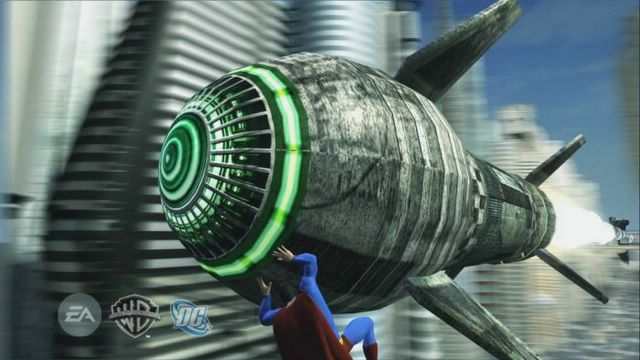
Metallo from the upcoming video game for Superman Returns.
posted by Matt Butcher @ 3:52 PM   0 comments

EA is releasing a new video game to coincide with the release of the new Superman movie coming out this summer. All I have to say of these game screenshots, pictures of a pitched fight between Superman and the villain named Metallo, the robot with the heart of Kryptonite, is...Wow. Looks great.
posted by Matt Butcher @ 3:49 PM   0 comments

You have to love film rumors. We geeks will rumor about movies and their sequels years in advance. They are already talking about the Superman Returns sequel and we still have about 125 days until Superman Returns comes out! They are looking at Bryan Singer to direct the sequel, due to be released in 2009. Bryan Singer may direct the re-make of Logan's Run (another re-make for the world!) and then film Superman Returns. It may be in Vancouver, British Columbia, this time and not Australia. Everything seems to be filmed in Vancouver over the past decade.
posted by Matt Butcher @ 3:42 PM   0 comments
Friday, February 24, 2006

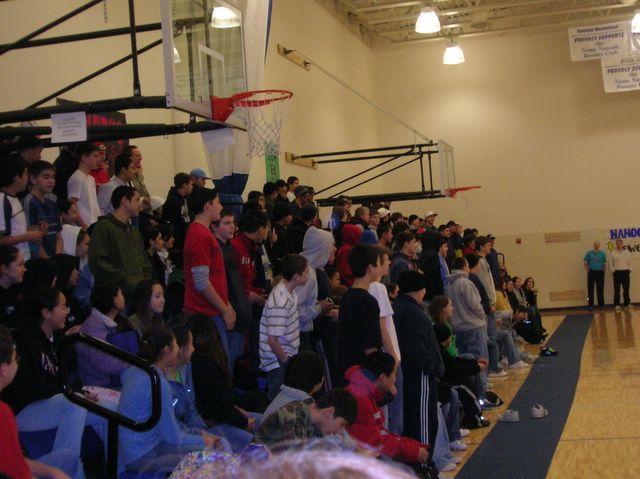
This is a closer picture of our 7th and 8th grade.
posted by Matt Butcher @ 8:26 PM   0 comments

Our school cheers pretty well when duty calls.
posted by Matt Butcher @ 7:39 PM   0 comments

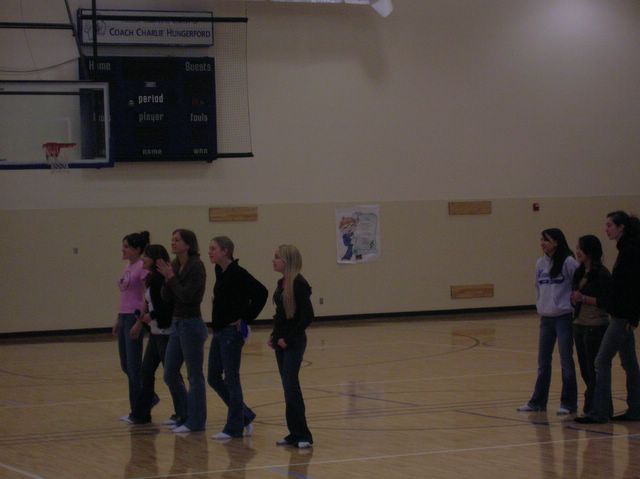
These are our cheerleaders starting us off during the pep assembly. For some reason, they did not wear their cheer outfits.
posted by Matt Butcher @ 7:35 PM   0 comments

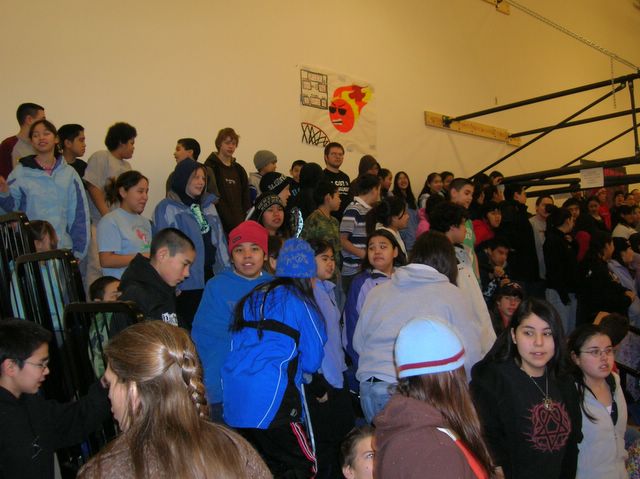
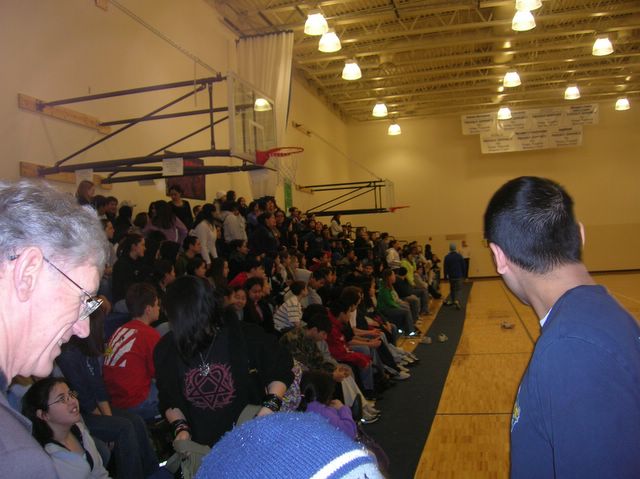
Inside the new gym, this is pretty much a picture of the entire school, 7-12. That's our principal, Mr. Carter on the left.
posted by Matt Butcher @ 7:35 PM   0 comments

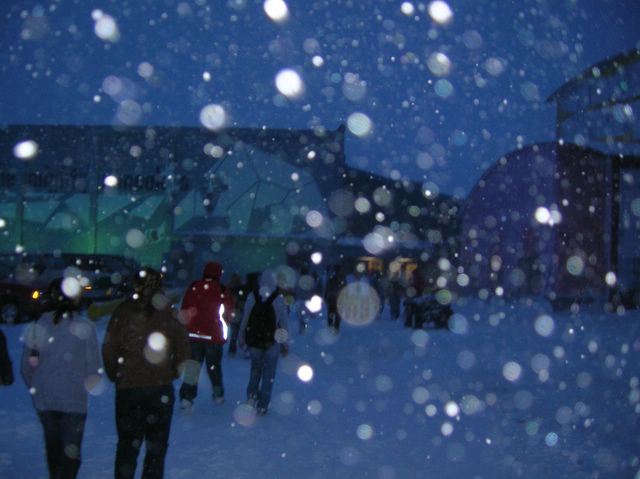
Even though it was terrible out and the Barrow games ended up being cancelled for this weekend, we still had our pep assembly! We have to walk outside right now to get to the gym. I don't know how well you can make it out, but on the right hand side of the picture is the cafeteria and tunnel that is under construction that will enable one to walk to the gym without going outside. On the left and straight ahead is our gym. You may be able to make out the Mighty Nanook drawing on the wall in the center of the picture.
posted by Matt Butcher @ 7:34 PM   0 comments

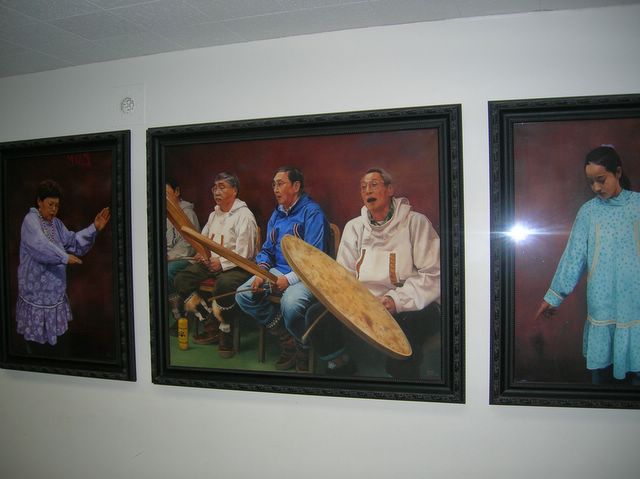
Inside our building are a ton of native pictures. Many actual elder photographs are on the wall. These are three paintings that are right next to the main office that showcase native singing and dancing.
posted by Matt Butcher @ 7:27 PM   0 comments

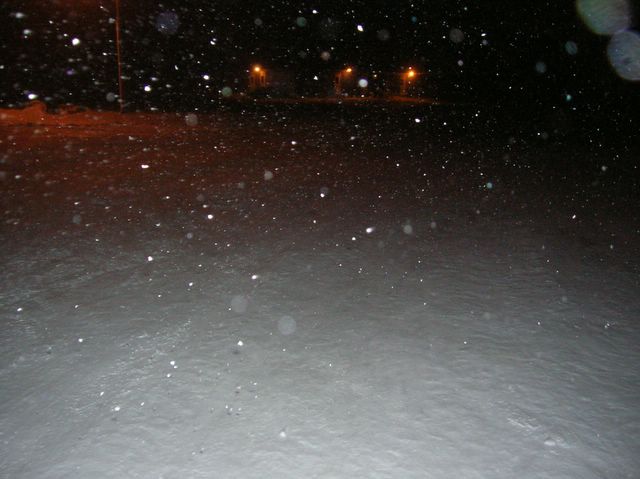
On my way to work. I walk because it is close enough. It is still cold though with blowing snow and a wind chill of -20!
posted by Matt Butcher @ 7:24 PM   0 comments

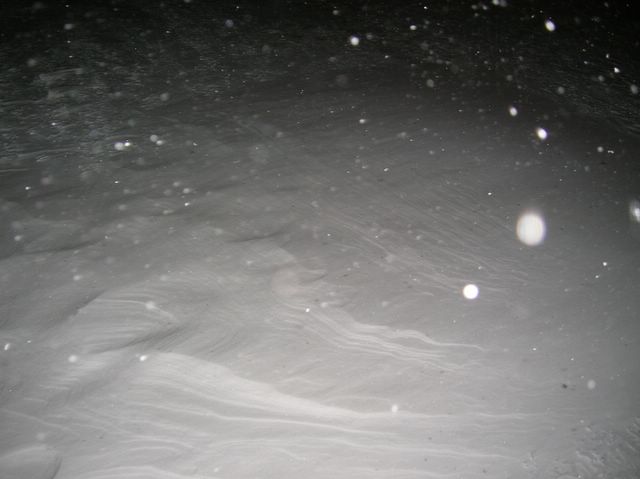
That's snow, man. The wind carves it into interesting patterns on the ground.
posted by Matt Butcher @ 7:22 PM   0 comments

Walking to work this morning at about 7:40 am, I thought I'd catch a picture of the new blizzard that is upon us. We are supposed to get 5 to 8 inches tonight. The Barrow basketball teams weren't able to make it here today.
posted by Matt Butcher @ 7:18 PM   0 comments
Wednesday, February 22, 2006

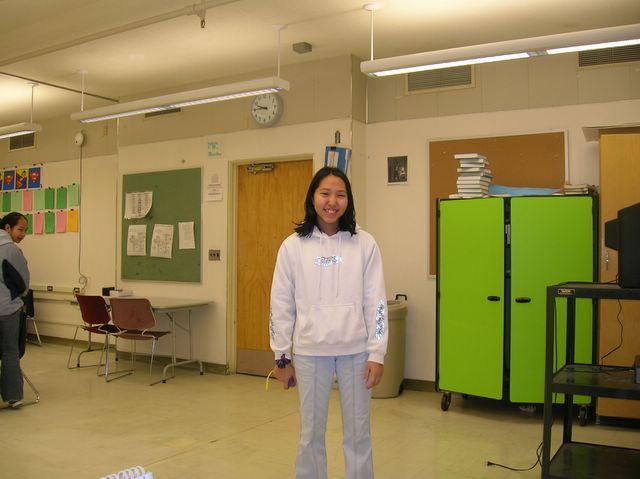
Took some pictures of some of my students today. This is Rachelle.
posted by Matt Butcher @ 8:31 PM   0 comments

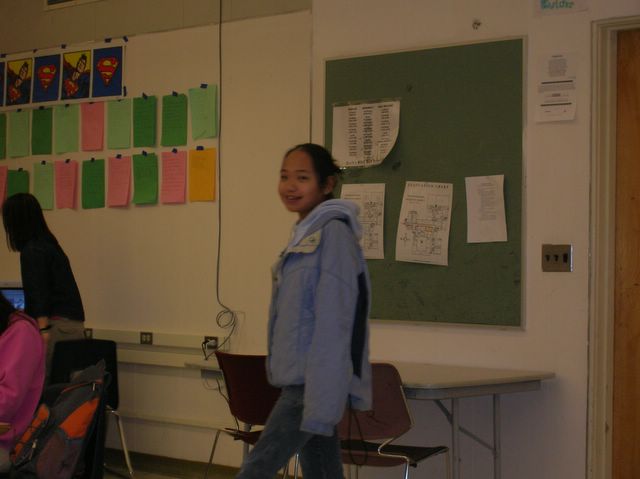
This is Valerie.
posted by Matt Butcher @ 8:29 PM   0 comments

We have a stuffed polar bear in the common area of the school. Isn't that sweet? We are the nanooks after all, which is a native word for polar bear.
posted by Matt Butcher @ 8:28 PM   0 comments

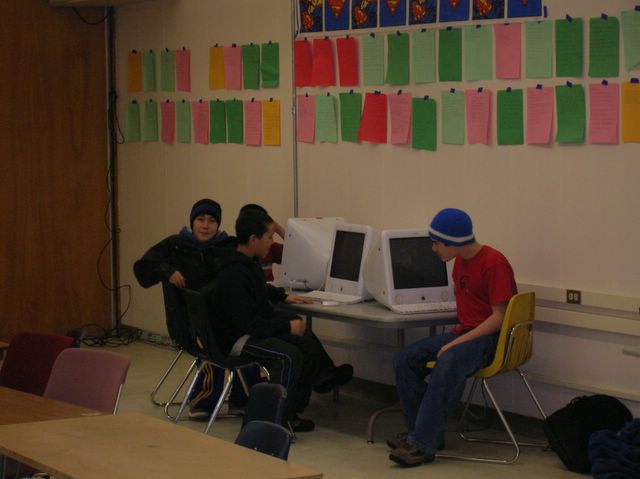
The boys jump on the computers as quickly as they can.
posted by Matt Butcher @ 8:28 PM   0 comments

This is my sixth period class. They did a great job on their Shakespeare speeches today.
posted by Matt Butcher @ 8:26 PM   0 comments

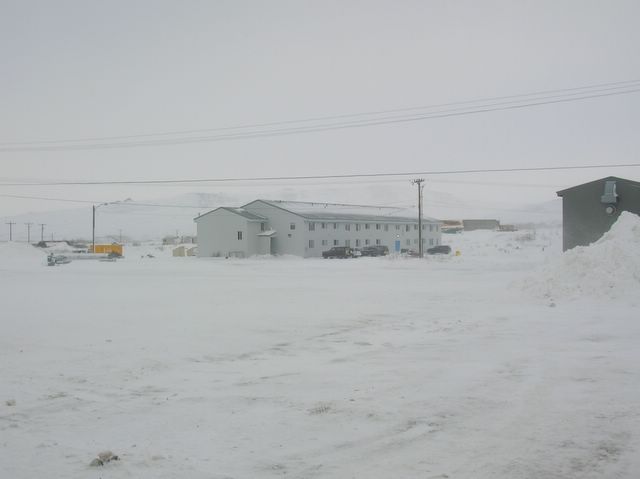
More wind and snow today. This is our apartment complex as I am standing in the back door of the school. Now that is the perfect commute.
posted by Matt Butcher @ 8:26 PM   0 comments

She sure loves her ballerina outfit. It is so much fun to see her dance.
posted by Matt Butcher @ 8:23 PM   0 comments

The snowman even dwarfs her creator.
posted by Matt Butcher @ 8:23 PM   0 comments

Morgan, up close and personal.
posted by Matt Butcher @ 8:22 PM   0 comments

No, this face wouldn't pull a fire alarm, would it?
posted by Matt Butcher @ 8:19 PM   0 comments

Here is Madison next to the huge snowman that Morgan built.
posted by Matt Butcher @ 8:18 PM   0 comments

Did you know that Madison pulled the fire alarm yesterday, causing everybody to panic?
posted by Matt Butcher @ 8:16 PM   0 comments

When Amy got home from Fairbanks, Madison got a little surprise: a ballerina costume! She loves playing dress up. I don't think she has taken it off since yesterday.
posted by Matt Butcher @ 8:10 PM   0 comments
Tuesday, February 21, 2006

God, I'm ugly.
posted by Matt Butcher @ 11:57 PM   0 comments
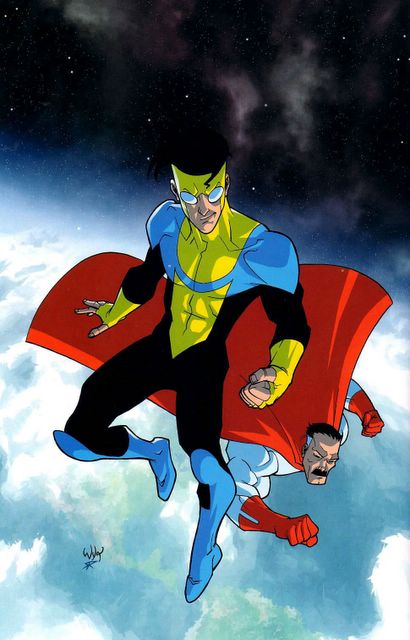
Invincible

When you look for a new series and actually find one worth reading, it is worth shouting about.

Robert Kirkman and Ryan Ottley have put out one hell of a new series. It's from Image Comics of all places and it is called Invincible.

I just got done reading the first ten issues and am thoroughly addicted. It's about this kid, whose father is the Superman-like character known as Omni-Man, who just gets his powers. It is sort of like that premise with the movie Sky High.

Instantly, these creators made these characters thoroughly likeable and human. If there really were superheroes with these powers and abilities, this would be what they really did. The kid is a mini-Superman and gives himself the name Invincible. He is brash and feels like early Peter Parker. Omni-Man makes being trapped in a different dimension for months somehow run-of-the-mill office work.

This is fantastic stuff. And with the twists and turns of issues 7-10, it is also good, suspenseful fiction. I can't remember the last time I was so excited to get into the next issue of a comic.
posted by Matt Butcher @ 1:47 AM   0 comments
Monday, February 20, 2006
North Slope of Alaska

RedOrbit.com puts out all sorts of pictures of pace and Earth images. I found this one interesting of the North Slope of Alaska. I have been to Barrow twice now so I feel closer to the area. I think the following article helps to explain the differences between ice floes and what actually happens in a frozen ocean.


Along the northern Arctic shores of Alaska, ice, snow, and cold dominate the landscape, even on a sunny day in June. This false-color satellite image shows electric blue ice and snow, the green vegetation of the hardy plants and mosses of the tundra, the deep blue of flowing rivers and open ocean, and pink-hued outcrops of bare, rocky ground.
The tundra runs the length of northern Alaska and is known as the North Slope. Only a surface "active layer" of the tundra thaws each season; most of the soil is permanently frozen year-round. On top of this permafrost, water flows to sea via shallow, braided streams or settles into pools and ponds. Along the bottom of the image the rugged terrain of the Brooks Range Mountains is snow-covered in places (blue areas) and exposed (pink areas) in others.
The sea hadn't surrendered to approaching summer. Along the coast, fast ice still clings to the shore in a solid, frozen sheet. At the top of the scene is the drifting sea ice. A dark blue strip of open water, known as a flaw lead, separates the fast ice from the drifting sea ice. Because the drift ice wanders freely with the wind and sea currents, it shatters into pieces that become rounded from the constant jostling.
posted by Matt Butcher @ 11:46 PM   0 comments
Cool Guy Kurt Busiek
This is pretty cool.

While I was in the message boards at Comicon.com, I came across an entry by comic author Kurt Busiek (author of Red Tornado, Astro City). A lot of comics professionals come to the site every once in a while. Peter David (author of Hulk, Spider-Man, numerous Star Trek novels) actually responded to one of my posts not too long ago. Feel like I am rubbing elbows with some personal heroes.

So I wrote to Kurt Busiek. I had just read his 1984 series Red Tornado from DC Comics in the stack of comics I ordered through Mile High at the turn of the year. I thought I would just let him know that I really enjoyed it, even after all this time, that it still holds up.

He wrote me back. Not much, but recognition anyway. He sent me a link to a comic book series called Astro City that he has done. I had never heard of it before but I read the link, a 3 MB 15 page PDF file of a comic in the series. It was great. Very reminiscent of old EC Comics.

Just cool to have a guy respond to a reader. That shows character. So buy his stuff 'cause he is a cool guy.

(and for my own records, here are the emails all together:)

Hi there. I got your email off Comicon.com. I am a fan. I finally got to read your Red Tornado series from 1984. I ordered a bunch of old comics from Mile High Comics. I just wanted to say that I loved it. It was a great little mini-series. I was really surprised by how much I liked it. I know it was a long time ago, but I just wanted to let you know that it still holds up.

Thanks,
Matt Butcher

Thanks! Glad you liked it.

kdb

Read an ASTRO CITY story for FREE, at: http://www.dccomics.com/features/astro/

Hey that link you sent me for Astro City--that was fantastic. Like one of the old EC comics. Wow. Why have I never heard of this series? I am going to look for it now.

Great work!
Thanks,
Matt

Glad you liked it -- it's my main claim to fame, over the years. There are five trade paperback collections of it so far, and more on the way...!

kdb
posted by Matt Butcher @ 11:44 PM   0 comments
Inservice
Two days of this. Two days.

I am not against teacher inservice days but I do wish they were used wisely. This is an opportunity to really show us teachers all of these teaching techniques that really work. But they simply lecture. Show us! Inspire us! Mold us and shape us into these fantastic teachers that you keep asking us to be. These two days could really be presented to show us some fantatic teaching strategies. And you lecture to us.

It's not just here. They did the same exact thing at Bremerton. And the same exact thing at South Kitsap.

Inspire us. An hour on Inhalant Abuse Prevention where we just read Power Point slides? Stats, stats, stats. Tell us what to do about it.

My name should have been Matt Bitcher.

But I want to be inspired. I really do. I just can't come up with all of this stuff on my own.

Like the SmartBoard training. I really would like to use it and learn more about it. But I know there will only be one at the elementary school and one at the high school. I'll never get to use it consistently. I can't even sign up for the computer lab half the time!

Show me how to incorporate one hell of a lesson using the SmartBoard to teach a lesson about Inhalant Abuse. That would be awesome. Get me to do something just like you would have me get the students to do something. It was right there. Right there.

Lunch is almost up. I have to go back.
posted by Matt Butcher @ 3:30 PM   0 comments
Toys

I am a real geek. I just preordered Artoo Potatoo and Spud Trooper from Entertainment Earth.

Look at 'em. They're adorable. I received Darth Tater for Christmas and when I saw these available in the next few months, I have to keep up the collection. Madison loves playing with Darth Tater, even though she likes sticking the tongue in the top of the head.

Yeah, I could say that I have an ulterior motive with a two-year-old (almost three!) at home to play with them, but I won't. These are as much for me as Madison.

I love toys.
posted by Matt Butcher @ 2:53 AM   0 comments

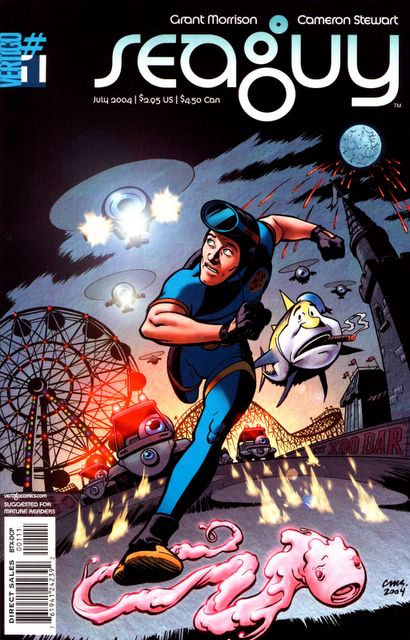
Okay, I don't get it.
I finally got to read this three-issue limited series from DC's Vertigo Comics label. It is written by fan-favorite (and one of my favorites) Grant Morrison. All right, everything sounds fine. That's a good beginning. DC. Vertigo. Morrison. Guaranteed a good time.
Except I don't know what I just read. I don't get the point.
It was interesting. It was very well drawn by Cameron Stewart. It was a bit surreal. Seaguy's partner was some floating fish called Chubby the Choona. Weird, but doable. Hey, this is comics after all.
At first, I thought we were going to have a good little futuristic plot to uncover the secrets behind the foodstuff known as XOO. (I was pronouncing it "ZOO," and I hope that was right.) That is what that little pink critter is on the cover. The story is set in the time period where superheroes are no longer needed. The first issue may have led to good things.
But the second two issues led us on some kind of quest that does not deliver a final point. I hope someone out there can give me a final point, message, or theme to the whole thing. I soon will hold a Masters degree in English literature and I have no idea.
Grant Morrison missed with this one. However, this is only one miss out of a long line of hits.
posted by Matt Butcher @ 12:54 AM   0 comments
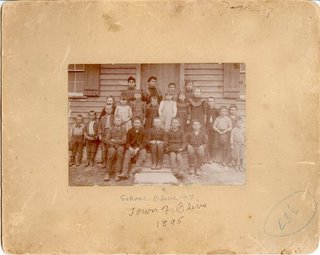
1898 Eighth Grade Final Examination


1898 Eighth Grade Final Examination

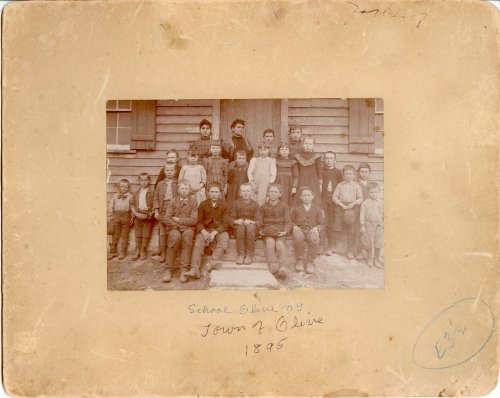
Quite amazing to me. So much for SAT’s after 12 years of schooling in advanced classes. This is what it took to get an 8th grade education in 1895.

Remember when grandparents and great-grandparents stated that they only had an 8th grade education? Well, check this out. Could any of us have passed the 8th grade in 1895? This is the eighth-grade final exam from 1895 in Salina , Kansas, USA . It was taken from the original document on file at the Smokey Valley Genealogical Society and Library in Salina, KS, and reprinted by the Salina Journal.

8th Grade Final Exam: Salina, KS -1895

Grammar (Time, one hour)

1. Give nine rules for the use of capital letters.
2. Name the parts of speech and define those that have no modifications.
3. Define verse, stanza and paragraph.
4. What are the principal parts of a verb? Give principal parts of"lie,""play," and "run."
5. Define case; Illustrate each case.
6 . What is punctuation? Give rules for principal marks of punctuation.
7 - 10. Write a composition of about 150 words and show therein that you understand the practical use of the rules of grammar.

Arithmetic (Time, 1.25 hours)

1. Name and define the Fundamental Rules of Arithmetic.
2. A wagon box is 2 ft. deep, 10 feet long, and 3 ft. wide. How many bushels of wheat will it hold?
3. If a load of wheat weighs 3942 lbs., what is it worth at 50cts/bushel, deducting 1050 lbs. for tare?
4. District No 33 has a valuation of $35,000. What is the necessary levy to carry on a school seven months at $50 per month, and have $104 for incidentals?
5. Find the cost of 6720 lbs. coal at $6.00 per ton.
6. Find the interest of $512.60 for 8 months and 18 days at 7 percent.
7. What is the cost of 40 boards 12 inches wide and 16 ft. long at $20 per metre?
8. Find bank discount on $300 for 90 days (no grace) at 10 percent.
9. What is the cost of a square farm at $15 per acre, the distance of which is 640 rods?
10. Write a Bank Check, a Promissory Note, and a Receipt

U.S. History (Time, 45 minutes)

1. Give the epochs into which U.S. History is divided.
2. Give an account of the discovery of America by Columbus.
3. Relate the causes and results of the Revolutionary War.
4. Show the territorial growth of the United States.
5. Tell what you can of the history of Kansas.
6. Describe three of the most prominent battles of the Rebellion.
7. Who were the following: Morse, Whitney, Fulton, Bell, Lincoln, Penn, and Howe?
8. Name events connected with the following dates: 1607, 1620, 1800, 1849, 1865.

Orthography (Time, one hour)

1. What is meant by the following: Alphabet, phonetic, orthography, etymology, syllabication.
2. What are elementary sounds? How classified?
3. What are the following, and give examples of each: Trigraph, subvocals, diphthong, cognate letters, linguals.
4. Give four substitutes for caret 'u.'
5. Give two rules for spelling words with final 'e.' Name two exceptions under each rule.
6. Give two uses of silent letters in spelling. Illustrate each.
7. Define the following prefixes and use in connection with a word: bi, dis, mis, pre, semi, post, non, inter, mono, sup.
8 . Mark diacritically and divide into syllables the following, and name the sign that indicates the sound: card, ball, mercy, sir, odd, cell, rise, blood, fare, last.
9. Use the following correctly in sentences: cite, site, sight, fane, fain, feign, vane, vain, vein, raze, raise, rays.
10. Write 10 words frequently mispronounced and indicate pronunciation by use of diacritical marks and by syllabication.

Geography (Time, one hour)

1. What is climate? Upon what does climate depend?
2. How do you account for the extremes of climate in Kansas?
3. Of what use are rivers? Of what use is the ocean?
4. Describe the mountains of North America.
5. Name and describe the following: Monrovia, Odessa, Denver, Manitoba, Hecla, Yukon, St. Helena, Juan Fernandez, Aspinwall and Orinoco.
6. Name and locate the principal trade centers of the U.S.
7. Name all the republics of Europe and give the capital of each.
8. Why is the Atlantic Coast colder than the Pacific in the same latitude?
9. Describe the process by which the water of the ocean returns to the sources of rivers.
10. Describe the movements of the earth. Give the inclination of the earth.

Notice that the exam took FIVE HOURS to complete. Gives the saying "he only had an 8th grade education" a whole new meaning, doesn't it?
posted by Matt Butcher @ 12:28 AM   0 comments
Sunday, February 19, 2006

Amy had to go to Fairbanks for a couple of days for work. It's only two sleeps but we already miss her. She had to fly on her first smaller plane by Frontier Air. We dropped her off tonight at 7 for her 7:30 flight. It was rather busy there.They cancelled the little flights to Teller and Brevig Mission. Amy has to make one little stop in a small community called Ruby and then on to Fairbanks. WIth this trip, this family has been pretty much all over the state now, except for the state capital of Juneau.
posted by Matt Butcher @ 11:24 PM   0 comments

Morgan and her friend made a huge snowman yesterday.
posted by Matt Butcher @ 1:38 PM   0 comments
Saturday, February 18, 2006

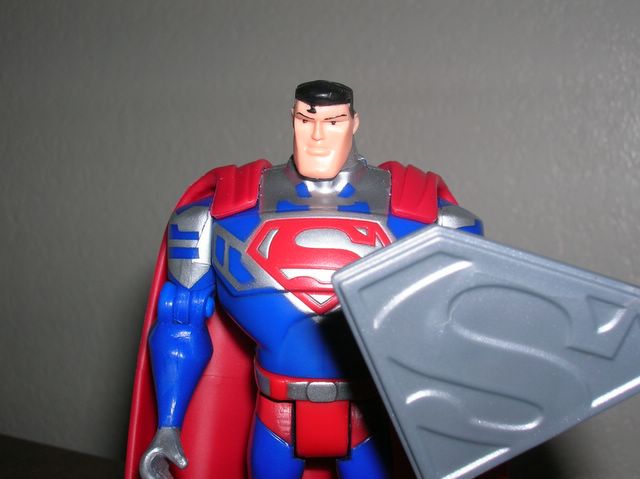
Even I got a new toy. I got this Anti-Amazo Superman figure. Madison loves watching the old Fleischer Superman cartoons from the 40s with me.
posted by Matt Butcher @ 7:37 PM   0 comments

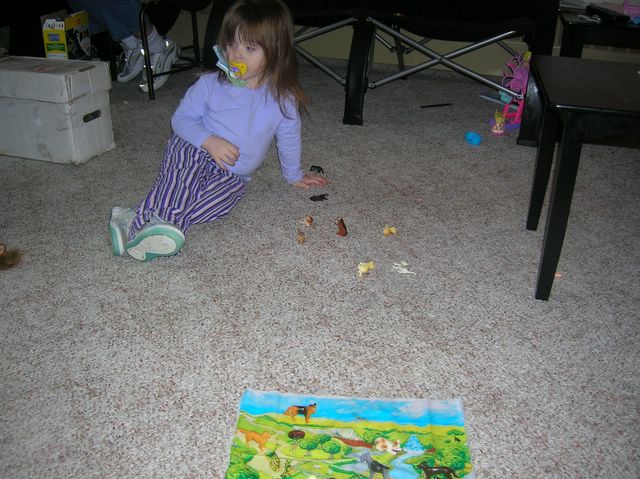
Madison is playing with her new toys, some plastic dogs that came in a tube.
posted by Matt Butcher @ 7:35 PM   0 comments

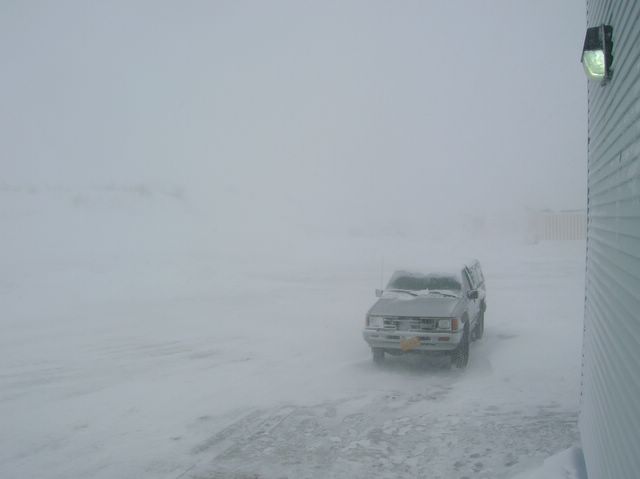
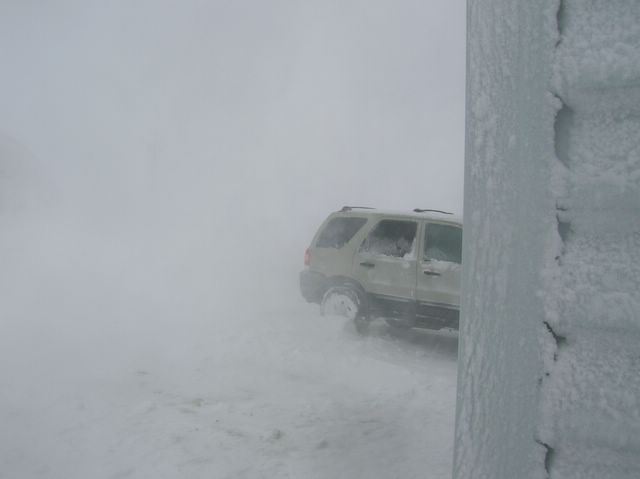
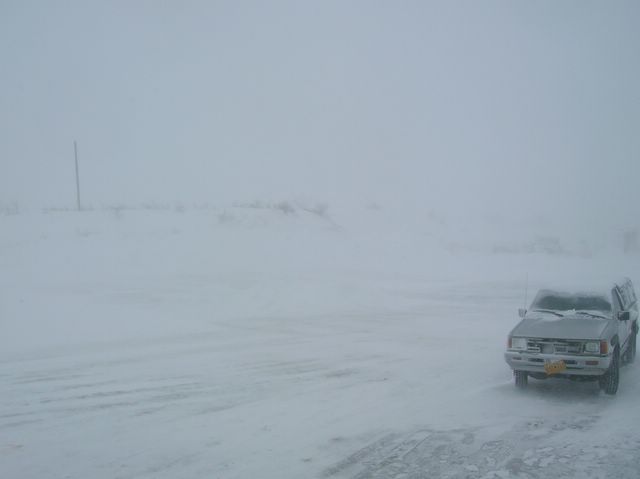
These pictures don't really do justice to the wind whipping around.
posted by Matt Butcher @ 7:31 PM   0 comments

Here's a car parked by the building as a wind gust really picks up. I almost got knocked over coming around the corner there.
posted by Matt Butcher @ 7:30 PM   0 comments

Had a bit of a blizzard again today. Gusts up to 50 mph. Amy actually had us go out in this out to the store.
posted by Matt Butcher @ 7:29 PM   0 comments
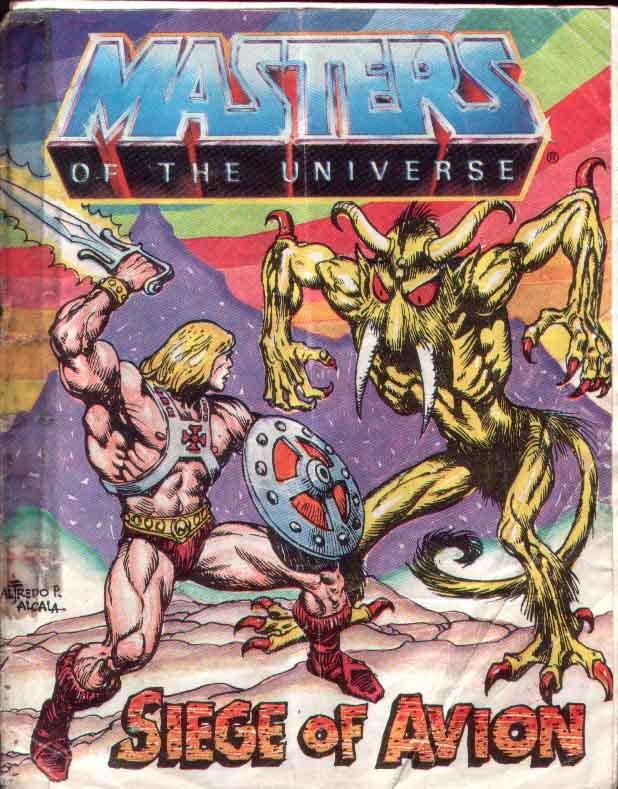
Masters of the Universe and the Siege of Avion

Siege of Avion

In this exciting mini-comic, we got all the product placement we could ever want as kids!

Avion, the home of the Bird People led by Stratos (who we find out has a human wife), is attacked by some cave-dweller people known as the Ilkorts. Fine and dandy. We got to see He-Man and Battle Cat, Teela and Man-At-Arms, and of course, Stratos. We got to see He-Man shout, “Teela, to the Talon Fighter!” That was another one of the fancy vehicles they tried to get us to buy. I don’t think I ever had that one.

Skeletor has apparently set up this attack in order to get this Emerald Staff of Avion. The attack was just enough of a distraction. Skeletor wants to use it to call a demon called Haramesh in to destroy Castle Grayskull. (What the peaceful Bird People are doing with a staff that conjures demons though is beyond me.) We also get to see Snake Mountain, which was also a playset but was the home of the bad guys.

Stratos swoops down to retrieve the staff right out of Skeletor’s hands and He-Man uses it to banish the demon away. Kind of a simplistic ending, but it did its job. It got me to play He-Man and come up with my own adventures.

This was a good little mini-comic. It helps to establish the universe that the figures are set in and gives plenty of adventure. Just trying to duplicate the story would take a lot of fun playing time. Coming up with improvements and then coming up with your own adventures, which I did ad infinitum, was an integral part of my growing up.

This mini-comic was downloaded free of charge at Good Old Days.

posted by Matt Butcher @ 2:26 AM   0 comments
Eskimo Heritage Reader part 12
Fish River Wars

“AWHHHHHHHH! AWHHHHHHHH! AWHHHHHHHH!” They say that before the wars, the seagulls in the Fish River never used to do that. But after they feasted on the bodies of the dead, they began to cry like that. They had a new cry because they had eaten human flesh.
According to my father, there were three main invasions on the Fish River. The last war was around my father’s time. My dad was about 14, 15 years old at that time.
So there was warfare even on Eskimo land. Eskimos and Indians made war all the time. Sometimes they fought for land or for women. Often they fought for vengeance, just to keep the wars going.
After a war, the survivors would return to their village. Then there came a time of few berries. Finally, after many years, the village would grow again. Then when they had multiplied and raised up an army, they would go to war again.
If a young boy had somehow escaped, he would talk for years about the people who had killed his parents. For a long time, it was just talk, but that was the only way they thought about that other village. Always they thought of revenge. For many years, they worked to build up their war selves. They went to the mountains near the Fish River to gather flint for their spears and arrows. I’ve heard that flint was pink and very hard. This happened before my father’s time.
My great-grandfather, Miyuruqtuq, died in those wars. He was about 20 years old, in the prime of life. His son, my father’s uncle, was a little baby at the time. His name was Pikshuk. He was given dried salmon eggs to chew on. He remembers a whole bunch of kids in the house chewing on this kuzgi. He didn’t know there was a war at the time. When he grew up, he learned why the children were given dry fish eggs to chew on. It was to keep them quiet.

By Job Kokochuruk of White Mountain
posted by Matt Butcher @ 1:38 AM   0 comments
Old Justice League Comics

It is interesting to re-read the old Justice League comics that came right after the Crisis in 1985. In light of the villain that has apparently been Maxwell Lord, seeing him in these beginning comics is kind of creepy.

Maxwell Lord is just a plain old human, or so he thought (or led us to believe). He was called a “billionaire industrialist” many times in the comic series.

He helped start the new Justice League and get it its “International” standing. Now the Justice League was like the superhero police force of the countries of the world. He helped start the team by instigating the first little predicament in the United Nations: he hired a handful of terrorists to seize the UN and then have his people come in and save the day. He didn’t tell the terrorists that he didn’t give them the trigger to the bomb.

Then he also set up the little fracas that had Booster Gold prove his worth to the team by defeating the Royal Flush Gang on his own.

By issue #12, the League should have seen more of the impending coming of the villain Maxwell Lord. He had even planned the murder of his boss in his previous company just to seize power. Even though it didn’t quite happen the way he wanted, a real accident while spelunking and not a murder, he seized power and led the company. His building is filled with protective devices. He seems ready for war already.

The Metagene Bomb, or whatever it was exactly called, that went off during the Invasion crossover series and three-issue event in the late 90s was intended by the aliens to eradicate the superpowers of everyone on earth. The groups of aliens that got together were afraid of all the super powers on earth and wanted to extinguish them. It only affected super powers. So why did Maxwell Lord become affected?

It ends up that Maxwell Lord is a metahuman. His power is to influence. He can “nudge” somebody psychically. If he wants the remote control, he can “push” you to get up and get it for him. If he wants a company to sign a really bad contract for them, he can push it into his favor. He’ll make you turn right when you wanted to turn left. He’ll make it seem like it’s all your idea. Maybe he didn’t realize that he had this power, even though he gets a nosebleed whenever he uses it (I have to see when these nosebleeds started—it might be a retcon), he has always used the power, at least in the business world.

Then he started using it for really evil purposes. Somehow, he has figured that the metahumans would be the death of all the regular humans, sort of like humans versus mutants in the Marvel titles. He makes a case in that the metahumans are like gods among men, and anything in their wake gets destroyed.

For years, and I hope DC really goes into detail on this, he has been “nudging” Superman and getting him ready for complete will domination. This is Batman’s worst nightmare, and even if the JLA hated him for creating countermeasures in case this kind of thing ever happened, you can see that his fears are justified. In the middle of the mini-series called The OMAC Project, which was also interrupted by the four-part Sacrifice storyline that ran through the Superman and Wonder Woman titles, Maxwell Lord has made this final takeover of Superman’s will. Maxwell Lord has stolen Batman’s satellite overseer technology and perverted it into a metahuman killing machine. The superheroes are getting close to the culprit. Max plays his final card and “nudges” Superman to fight Wonder Woman with no quarter given. One hell of a fight ensues between two of DC’s most powerful characters. Wonder Woman ropes Lord with her lasso of truth and asks how to get Superman out of the trance. Lord answers the truth and only the truth, “Kill me.” She does so by snapping his neck. It was videotaped and broadcast to a world that is no in dire fear of the metahumans. Wonder Woman seems to have crossed that line that protected humans: no killing.

To see how far the evil went is amazing when you back track it through the Justice League comics. There are tidbits there. One of the writers at DC had said while they didn’t think Lord was a villain, “never once did I trust him.”
posted by Matt Butcher @ 1:29 AM   0 comments
Highly Qualified
Alaska calls teachers that are certified in their exact subject matter "highly qualified." Mostly, if you have a degree in your subject you are, or you have to take a specialized test. I just got my official recognition from district office:

Subject: Highly Qualified Status

Congratulations! We have processed your verification for Highly Qualified status. Our district representative Stan Lujan has signed it, you will receive a copy, with the original placed in your file. If you should have any questions, please call.

Thank you.
Cynthia
posted by Matt Butcher @ 12:07 AM   0 comments
Wednesday, February 15, 2006
Eskimo Heritage Reader part 11
The Omalik Mine

In the old days, people traveled into the mountains to hunt caribou. They would drive them to Inuguk and the lake there. As the caribou swam ashore, the hunters would spear them. Or they chased them with a kayak on the lake. This was a traditional butchering place.
Once my great-grandfather, Tugua, was driving the caribou down to the valley. He saw rocks shining on the ground in the mountains. The rocks were very heavy, so they called the place Omalik, which means “heavy.” Later, they learned they could make bullets out of these heavy rocks.
One summer, when they went to Golovin, a ship was there. They showed the rock to the captain. He wanted to know where it came from. The natives did not know any better so they showed him. They brought the captain and some others to Omalik. The white men staked a claim there and later patented it. That’s where the first gold and silver were mined on the Seward Peninsula.
They hired the Eskimos as workers in the mine. They hired their boats, too, for three seasons. My grandpa, John Ahwinona, was hired as a driller in the shaft. Each man was paid one fifty pound sack of flour for a season’s work. For clothing, they were given only gunny sacks. While they almost starved, they were hauling all this silver and gold ore to the ship.
The two brothers who took the Captain to Omalik went to the owners. They asked for food for the men and their hungry families. Instead of flour, they asked for pay. But the mine owners took those two men and shot them in front of their wives and children.
After they had done this, they shut down the mine and returned to their ship. The miners knew they killed two tribal leaders. They hurried to leave. Another ship was seen offshore. The Captain did not want anyone else to know all about their gold and silver ore.
This was in the fall, when the storms are fierce. The Captain had been warned to wait until after the storm, but he left anyway. When he got out on the high seas, the ship split in two. All those perished, including the Captain. Only a young cabin boy was saved. He did not even know what the ship was hauling.

By Carl Ahwinona, Sr.
posted by Matt Butcher @ 8:47 PM   0 comments
Shorefast ice

From Moon of the Bird Sling:

There is hardly anything to see now, except ice and snow.

--Arthur Tocktoo, Brevig Mission

Above: Broken shorefast ice, tuvam ayemqellgha, floating amid forming young ice, saallek.

Below: Shorefast ice, tuvaq, alongside very young ice, sallqaaq
posted by Matt Butcher @ 7:57 PM   0 comments
Tuesday, February 14, 2006

I had an interesting conversation with Lynn today, the reading teacher with me at the middle school. We talked about having to read essential literature. I may be changing my stance.

It seems to me that my previous list of the top ten books that all students should read before graduating is problematic. Can I really force a student to read something they have no interest in?

Take The Scarlet Letter for instance. I absolutely hated it as a junior in high school. It was a struggle to get through. Maybe it was the theme or the fact that they were talking about infidelity in marriage and I had no bloody clue as to what true fidelity or love was yet. I had barely had a girl friend up to junior year. How the heck did I know what the hell this novel was really talking about? And I remember hating it and I was in the highest honors English course. I have always been a top level reader. It wasn't that it was hard, it was that it was frickin boring.

Then I read The Scarlet Letter again in 2001. I had to because South Kitsap High School required it to be taught to the juniors. This was the only absolute literature requirement that South's English department chair was adamant on. And heaven help you if you disagreed with her. This time, being almost 28 years old and all the life that I had been through, I absolutely loved it.

Now it seemed to hit home. Now it seemed applicable and understandable. It wasn't this alien conglomeration of concepts. Now I saw the true reason that it was a classic. It wasn't because I was a better reader, it was because I was into it.

So what can you MAKE a kid truly read. They won't read anything if you make them. I have learned that now. I had kids voraciously read fantasy book after fantasy book but would not crack open the book that was assigned for class. Did I as an English teacher really assess this student on language arts and reading ability or did I grade his conformity to the classroom? Now that is a dilemma.

I may think about my Top Ten now as just a "guideline" for higher end readers to help them in their post-high school career. I still believe that they need to be exposed to the analogy that is the red letter A on Hester Prynne's chest. They may not have to read the stinking book though.

Assigning high-interest books in personal categories and choices is probably more important than what they actually read. That kid that read the fantasy books or that girl that was always reading those Palahiuk novels probably knew plenty of language arts. I knew that I was a good reader even though I read a thousand tons of comics.

Thing is...those comics made me read. I branched out into other readings because of them. I still read comics, for Christ's sake, but I still read! If that's what it takes, then I am going to have to analyze what I teach and what I actually want the students to learn.
posted by Matt Butcher @ 11:24 PM   0 comments

Woo-hooo! I finally did it! I cleared 10 million points on that 3-D pinball game called Space Cadet that comes with Windows! 10,312,500.
posted by Matt Butcher @ 9:55 PM   0 comments

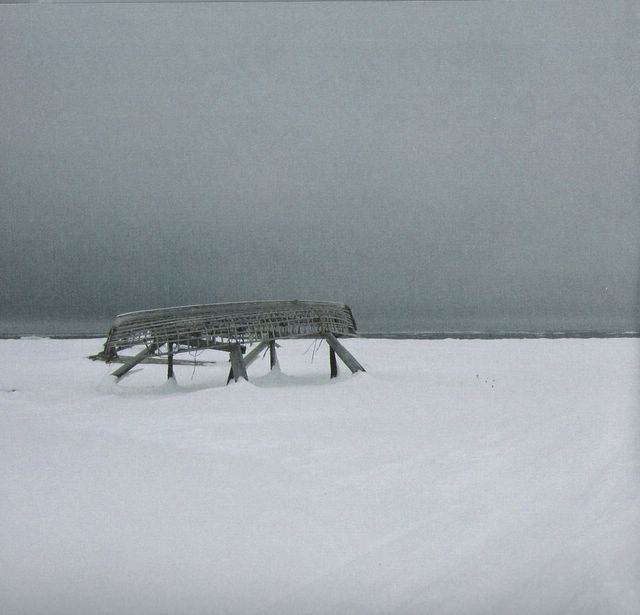
From Moon of the Bird Sling:

We are the people of the sea. We respect the sea and the sea brings us a lot of bounty.

Paul Ivanoff III / Unalakleet

Picture of a skin boat frame, angyam neghqwagha, Gambell, St. Lawrence Island.
posted by Matt Butcher @ 8:28 PM   0 comments
Monday, February 13, 2006

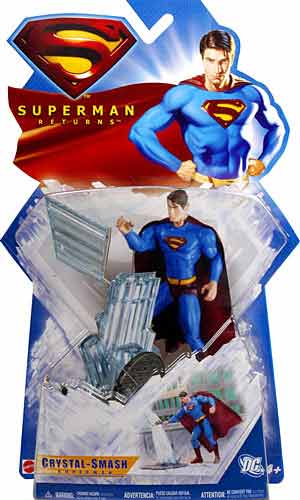
The new Superman Returns toys will come out soon. I think they used the molds from the Batman Begins line. Could that picture of Superman at the top be any dorkier? God, I hope this movie goes over well.
posted by Matt Butcher @ 8:35 PM   0 comments

Got a bit of a blizzard going on out here in Nome this evening. Winds up to 40 miles per hour. Snow is blowing all over the place.
posted by Matt Butcher @ 8:32 PM   0 comments

More of the blizzard. Note that you can't see any of the mountains that are behind the apartment complex.
posted by Matt Butcher @ 8:32 PM   0 comments
Sunday, February 12, 2006
Finding Stuff
How did teachers get along without the internet? It is such a vast resource with actual printed lesson plans! I found a full 87 page media literacy unit at www.medialit.org. What would I have done without it?

I can usually type "English lesson plan" into a search engine and get something.

Great for emergencies.
posted by Matt Butcher @ 5:01 PM   0 comments

Physicist Expects Near-Lightspeed Spaceflight This Century
If this is true, then we are getting closer and closer to the dream. This is that technological infancy I am always talking about.
posted by Matt Butcher @ 2:09 PM   0 comments
Saturday, February 11, 2006

In the copies of the old John Constantine: Hellblazer comics I acquired, this is a picture from issue #2, The Butcher's Hook, "a public house of less than salubrious demeanour." I didn't know that Constantine went all the way back to 1987.
posted by Matt Butcher @ 7:01 PM   0 comments

This is Anvil Mountain from further away, over on the lefthand side. On the right are those old radar installations leftover from the cold war that they don't want to take down.
posted by Matt Butcher @ 4:51 PM   0 comments

And here's just a shot of the family settling in.
posted by Matt Butcher @ 4:48 PM   0 comments

Here is a better tele-photo picture of the ice breakup.
posted by Matt Butcher @ 4:46 PM   0 comments

Then we went to the airport for the little cafe called "Taste of 270." I got my vanilla latte, the girls got some kind of smoothie, and Amy got her iced mocha-thing.
posted by Matt Butcher @ 4:45 PM   0 comments

Now looking away from the sun, you can see the ice break up in the middle there. I was standing right on the coastline as I took this picture.
posted by Matt Butcher @ 4:43 PM   0 comments

Across from the road on the other side of the water is an old rig that they used to put the dirt through to look for gold.
posted by Matt Butcher @ 4:42 PM   0 comments

I tried to tele-photo in a bit, but the breakup is pretty far out there. A lot of people lost their crabpots with the big warmup.
posted by Matt Butcher @ 4:42 PM   0 comments

Took some pictures today while we were out on the town. The Bering Strait just had a 50 degree temperature switch within the last week so it is starting to break up the ice a little. This shows the sun at about 11:15 in the morning.
posted by Matt Butcher @ 4:39 PM   0 comments
Monday, February 06, 2006

This may be stretching it a bit--comparing Superman to Jesus?
posted by Matt Butcher @ 9:02 PM   0 comments
Top Ten Books
I found an article that asked some authors what top ten books should schoolchildren read before they leave school.

Here's poet laureate Andrew Motion's list:

The Odyssey Homer
Don Quixote Miguel de Cervantes
Hamlet William Shakespeare
Paradise Lost John Milton
Lyrical Ballads Samuel Taylor Coleridge and William Wordsworth
Jane Eyre Charlotte Brontë
Great Expectations Charles Dickens
Portrait of a Lady Henry James
Ulysses James Joyce
The Waste Land TS Eliot

Motion says we shouldn't consider these books "elitist." Should all students read these before they graduate? Some, yes. However, I wouldn't wish my worst enemy to read Ulysses by James Joyce. I tried in college once and just was nowhere near ready, intellectually or developmentally. I don't know if I could do it now. And I am an English major getting a masters in English. One thing of note: there is only one American author in Henry James, and only two authors out of the United Kingdom with Homer and Cervantes. Are these really the books you want to represent humanity?

Philip Pullman, author of the His Dark Materials trilogy, also came up with a list:

Finn Family Moomintroll Tove Jansson
Emil and the Detectives Erich Kästner
The Magic Pudding Norman Lindsay
The Rime of the Ancient Mariner Samuel Taylor Coleridge
Where the Wild Things Are Maurice Sendak
The Ballad of Sir Patrick Spens (or other good anonymous ballads)
First Book of Samuel, Chapter 17 (the story of David and Goliath)
Romeo and Juliet William Shakespeare
A good collection of myths and legends
A good collection of fairytales

His collection is a little more manageable. I like the fact that he chose Romeo and Juliet over Hamlet. Somehow, R&J is a little more accessible to the average person. Hamlet is a little intimidating for anyone. I really like his two choices of simply "a good collection" of myths, legends, and fairytales. You can't single stuff out sometimes and these are the stories that make us human. There are a couple of good kids's books, although I am not familiar with the first two on the list and am going to put them in my cart at Barnes&Noble.com. While I really like Where the Wild Things Are, how can you include that and not a good smattering of Dr. Seuss?

Then they also asked JK Rowling, author of the Harry Potter series:

Wuthering Heights Emily Brontë
Charlie and the Chocolate Factory Roald Dahl
Robinson Crusoe Daniel Defoe
David Copperfield Charles Dickens
Hamlet William Shakespeare
To Kill a Mockingbird Harper Lee
Animal Farm George Orwell
The Tale of Two Bad Mice Beatrix Potter
The Catcher in the Rye JD Salinger
Catch-22 Joseph Heller

Her list seems a little more accessible. Unfortunately, I don't understand why Robinson Crusoe is on the list. I understand that it is an adventure story and not necessarily anything earth-shattering. Wuthering Heights is a tough read because it is actually long and boring. I really do like her choice of Animal Farm, To Kill a Mockingbird, and Catch-22 (even though I haven't read that one yet--better put that in my cart too). I especially love her inclusion of The Catcher in the Rye. I wonder why that one Beatrix Potter tale gets rated so high with her?

So it comes down to me. That's what all this is about. What are the top ten books that every student should read before high school graduation? In no particular order:

The Catcher in the Rye J.D. Salinger
To Kill a Mockingbird Harper Lee
1984 George Orwell
The Lord of the Flies William Golding
Romeo and Juliet William Shakespeare
The Scarlet Letter Nathaniel Hawthorne
Things Fall Apart Chinua Achebe
Bulfinch's Mythology
Grimm's Fairy Tales, Aesop's Fables, Hans Christian Andersen Fairytales (one choice here but they are short and sweet and should be analyzed and known)
Complete Mother Goose and a good smattering of Dr. Seuss


Those are the top ten. You can debate and pick apart any list. I chose these because of the cultural significance and analogy references that students will be exposed to in the world outside of school. Yeah, I kinda smeared the boundaries with the last two choices by including just a random assortment but these are tales that are being lost. People should know basic Mother Goose rhymes. The lessons learned in Aesop can be invaluable. Fairytales need to be read and known as they are in everything we see and read. Bulfinch's Mythology is an anthology of understanding all the stories and references in many many things. Do you know what a "Pyrrhic victory" is or why it was called that? This is the book that answers questions like that succinctly.

The Catcher in the Rye may be an individualistic book choice on my part, but I truly believe that there is a message that people should read, at least to understand that these thought that many feel need to be explored. Romeo and Juliet is an introduction to Shakespeare and should then advance into other stuff. (I remember we read Midsummer Night's Dream in middle school and that choice coulnd't be more wrong as the first Shakespeare that one could read.) 1984 is an absolute must to understand Big Brother and government control. The Lord of the Flies needs to be read to understand the basics of societal rules and the need for some rules. The Scarlet Letter needs to be read simply to understand the analogy that students will hear throughout their lives. Things Fall Apart is a great book from Africa that showcases that one culture's history book may not look like one from another culture. People need to know this stuff.

To Kill a Mockingbird is perhaps my most poetic of choices. It is the novel that may outshine all others. Not only is it written well, but the message it conveys is perhaps the most poignant and human of all things to understand.

I could include others. I think we would read to understand more Bible as literature if people weren't so worried about the First Amendment. The reason that almost all schools read The Outsiders is to get kids into reading, not because it is a good story or written well.

Maybe I will ask myself this question again next month. The original article is online at The Guardian Unlimited.

What would you choose?
posted by Matt Butcher @ 7:50 PM   0 comments
Friday, February 03, 2006
Seminar in Creative Nonfiction
This is the story I wrote for my last class, Creative Nonfiction. I'm not very happy with it. I think I really needed to slow down in the telling of it. It seems rushed near the end, probably because I wanted to get done with it.

Matt Butcher
Seminar in Creative Nonfiction
January 11, 2006
No Room at the Women’s Shelter

We were out of pop. It was Friday night and I was just going to stay home and watch a movie on cable. My wife didn’t want to watch the science fiction movie so she was already playing Clue with our eleven-year-old daughter Morgan while the baby slept. I had a craving. The juice in the fridge wouldn’t do it for me. I wanted pop. And a Snickers.

Templeton’s US Gas was less than a block away. It was one of those independently-owned little hick gas stations with two pumps that stocked munchies, cigarettes, and live bait. I stumbled into the empty phone stall next to the door as I held it open for a lady leaving with a six-pack of Heineken. She had to maneuver around a small Labrador that was chained to the drainpipe.

Two female coworkers behind the counter of lottery tickets and beef jerky must have shared four hundred pounds between them. I’ve seen them a hundred times before being in here but still had no idea what their names were. They knew me from teaching at the local junior high. They had sweat on their faces and exasperation on their lips as they talked to the lady that was using their phone from over the counter. Hearing snippets of the phone conversation, the ladies kept grumbling to each other and tried to get the phone back. I walked to the coolers in the back, past the chips.

“Yeah, we’re stuck here,” the woman said into the phone. For the first time, I actually looked at her through the glass of the cooler as I grabbed a two-liter of Diet Pepsi. She was haggard with that blond hair that looked like fettuccine noodles left out overnight. A faded denim jacket covered her skeletal frame. When she turned around, I noticed the nicotine-stained gaunt face and the wide eyes. The brush of the front of her hair reminded me of a music video I saw back in 1983 or so. Pat Benatar, I think it was.

Next to her, almost huddled inside the jacket, was a girl that looked about fifteen. She stood with mouth agape and sunken cheeks, of which I made a quick stereotype of a teenager that did not have it all upstairs. I had seen that look before in girls in my English class that never wanted to be in school, and as a teacher, I knew the prospects weren’t too high. She seemed defeated. Even her hair had less style than her mother’s.

I walked quickly down the candy aisle and snatched a King-size Snickers before I could think twice about the fat content. As I approached the counter with my three bucks to pay, the women behind the counter were only too eager to run to the register to help me out. They wanted away from that woman that had borrowed the phone only to put a stranglehold on it.

“No, the shelter is all full, they told me,” the woman said into the phone. Suddenly, I wanted out of the building. If I were watching TV right now, I would have turned the channel on those pictures of third world children in poverty, out of helpless frustration or the fact that there was nothing I could do. I don’t understand completely the feeling of disregard. If I was driving home from work and a car accident had stopped traffic, I still would feel inconvenienced as I saw the ambulance come down the road. I once joked with my wife during one of these car accidents, some line I saw out of a movie, “Somebody better be dead,” and she hit me in the shoulder, saying, “Matthew, that’s not nice.” All I knew is that I would be glad once I got my change and was out of there.

I didn’t have the six cents over the two dollars in cash, so I had to give all three of my bills. I waited impatiently for the 94 cents in change. She had to crack open the quarter roll. Her long fingernails prevented her from easily taking out the four pennies. I watched the secondhand on the clock on the wall behind her move imperceptibly slowly.

The woman on the phone hung up and began talking. She didn’t talk to anybody in particular, just to anyone within earshot. “The shelter won’t take us. My girlfriend is going to try to get here but she’s in Seattle right now. How long will it take her to get here?”

No one answered immediately. Then the second worker chimed in with, “We’re across the Puget Sound here in Bremerton. It’ll take her at least an hour and a half, depending on exactly where she is.” She said this as she looked at the clock. It was nine o’clock already. They closed at ten. Where were they going to stay until then?

“Well, we can stay here until she gets here, but I gotta do something about the dog,” she said as she thumbed toward the Labrador on the drainpipe.
“You have a dog, Matt,” the lady on the register said as she finally dropped the change into my waiting palm.

I stumbled over my words for a moment. And I don’t stumble over them very often. I’m an English teacher, prone to adlibbing entire classes when necessary. I’ve given lectures with no warning and not stumbled over myself. Something about the situation made me nervous. “Yeah, I have Milo.”

“Is there any way that you could take my dog for the night?” the haggard woman asked. “We’re stuck out here and my girlfriend is allergic. He’s a good dog. We’ll pick him up tomorrow.”

She kept talking, pleading, telling me how good the dog was and that it was only for the night. There was no place to say no. I can see how the women behind the counter had given up the phone to her, even with the payphone outside. I looked at the workers and then remarked about how I lived right out the window there. They looked at me as if I was their only hope, as if I was the light at the end of that tunnel. I could see how they would have to stay with her past closing, waiting for some woman from Seattle who may not come at all. And it was just the dog.

“I can take the dog for the night,” I said. And I went home with a new dog.
Milo went berserk when I got home, tugging after a new dog. They dry humped each other for a while as my wife looked at me with bewilderment and mouth agape. My daughter, of course, thought we had a new pet.

“No, sweetie, the dog is just here for the night.” I finally looked at my wife, Amy. “Is that okay, hon? I got stuck with him. There are these…women…at the gas station that don’t have a place to stay or something. The women’s shelter is full and the women behind the counter don’t know what to do. I thought taking the dog for the night was small. They got stuck with the two women.”

My wife relented after my impassioned plea. I called it my good deed for the week. After settling Milo down with a new dog in the house, I finally started watching the movie. I was half asleep on the couch when a knock came from the door.

Out the window as I got up, I noticed two quick things. First, it was ten-thirty. Second, I noticed it was that woman and her daughter from the store. Those women behind the counter sent them here. They must be checking on the dog.
I opened the door and she immediately started in. “My girlfriend can’t make it now. Is there anyway we can just sleep on your couch here until the morning? I can call another friend in the morning. Or I can try calling her now.”

I already had the dog inside. I wondered what my wife would say. I wondered how I was going to get out of this. One good deed all of a sudden was becoming way more than I signed on for. It was as if I started giving my money to those commercials about those third world children and then those children showed up on my doorstep.

I invited them in to use the phone again. This was my second mistake.

“Thank you so much,” the woman started. “We will just make a quick phone call to make sure where our friend is. She said she was on her way, but maybe she got lost…” Her speech drifted off in my mind as Amy peeked around the corner. They tried calling this other friend but he or she was unable to be reached.
I didn’t know what the hell to do. While she tried the phone again, I went to Amy and took her to the backroom. “What do I do?” I whispered with waving arms.

“What are they trying to do?” she asked, continually peeking through the hutch in the living room.

“They’re trying to call some friend from Seattle. They got stuck here and the women’s shelter was full or something. They want to spend the night on the couch. How do I get ‘em outta here?”

“I don’t know. You can’t just say, ‘Get out,’” my wife said. She was trying to think of somewhere to put them.

We went back and forth for a few minutes. We couldn’t come up with a realistic excuse why they couldn’t stay on our sofa. It was eleven o’clock at night now. Anything short of drop kicking them out now meant figuring something out for them. It seemed actually easier to let them stay now. We relented and said they could stay on the sofa, telling them that we had to leave pretty early, Amy to work at the hair salon and me and the kids going to Morgan’s soccer game.
My wife, daughters, and I went to our bedroom after I pulled out the sleeper sofa for them. I didn’t fall asleep for hours. I left the TV on and kept getting up to check the house. I peeked out the door, just before it started to creak. I felt like somebody spending his life peeping out his own peephole at the world.
In the morning, they tried calling more people as I got my eldest daughter ready for her soccer game. Amy worked early at the salon that day so she had already snuck out the back. Phone call after phone call. She even had to call long distance a couple of times. Apparently, she was from Oakland, I had gathered.
“We have to go to her soccer game,” I told them finally, when we only had moments to spare to get to the elementary school. “The gas station will let you use their phone again.”

I kept getting that rapid, senseless talk again from her. “Well, my friend from Seattle said she got lost last night. She’s in Gig Harbor now and coming soon. She used to live in California near us.” Again, more useless information. I just wanted to know when they’d be out of there.

I finally picked up their two bags myself and brought them out to the porch. I had my daughters with me, one in her orange soccer uniform, one baby all bundled up on my arm. “We have to go.” I was adamant now. Somehow, the daylight made it easier to kick them to the curb.

I locked up and left them on the porch as I pulled away in the Explorer. My daughter finally asked, “Dad, what was that all about?”

I paused before answering. I could give her the truth, that I got stuck and didn’t know how to throw out a piece of trash woman and her daughter. I could tell her that I couldn’t come up with a good excuse or a good lie. “Remember when we read about Jesus saying to take people in because you never know if they are angels or not? Well, I just helped out a bit.” I just lied to my daughter. Angels don’t thrust themselves upon you. I doubt I would’ve helped at all if I weren’t forced against a wall.

I half expected them to be on my porch still when we got back. I saw the dog tethered to the drain pipe of the gas station as we pulled in. We went inside and stayed there. If they were angels, it was time for somebody else’s good deed. I reminded myself never to buy another candy bar from that place again, no matter how bad my craving.


Matt Butcher
Essay on Revision
January 26, 2006


After writing the piece the first time, I was actually quite proud of myself. For once, I actually finished a piece that I always wanted to write. That is one great thing about due dates. I never finish stuff when I am outside of class. I must have hundreds of little stories started but none of them are finished.
After I read the critiques from the other students and the teacher, I was depressed. Now there were a ton of changes to make to the real soul of the piece. The terrible part is that I agreed with all of them.
Trained in literature and criticism, I can dissect a text. After one fabulous freshman English teacher who taught me to separate myself from my text so that I can revise it, I can even rip apart my own stuff. Now it is just fixing it that is the problem.
I agreed with one major problem with my work. I agreed that it was rushed near the end. I know that I can set up a story. I have done that a million times. Somehow, I have noticed that I get bored with myself writing it, knowing where the story is going. When you know the end in your head, it seems hard to me to write the middle. I go into a story with all due readiness. Midway through, I falter and just want to finish the darn thing. I know that’s my biggest writing fault but I can’t seem to help it.
As I tried to revise the piece, what I found was that the majority of it was the feeling of being rushed. The critiques all said they wanted to hear more dialogue and know the character’s inner feelings. I tried my best to peeper it with some of that. To be honest, now I feel that it seems like it was done on purpose, that any of the creative spark was gone. I seemed to be forcing it into place. I agreed with it needing to be done though. However, now writing snippets of dialogue was tough.
There is one point about the story that I wanted to make but just didn’t come across too well. I didn’t want a sappy ending. This is a true story and I didn’t have a revelation about angels or being nice. I was put out by these people and wanted them the hell out of my home. Some inner moral code prevented me from kicking them out completely but I felt perturbed they were there. There wasn’t some final revelation. So I changed the title. I paused for about an hour on “A Little ________” but couldn’t find anything to fill in the blank. I needed something like favor or step that brings you to worse things, but couldn’t find an appropriate one. So I settled on the only reason I let them stay at all, “No Room at the Women’s Shelter.”
posted by Matt Butcher @ 8:35 PM   0 comments
Eskimo Heritage Reader part 10
Reindeer Herding

In the spring the reindeer begin to shed their hair. The flies irritate their skin, and the hide is no good to use. Often they move out to the coast to wade in the ocean, lapping up slat. They drink water from the streams and eat fresh greens. When they finish shedding, the skin becomes strong again and the deer grow fat. They stay lean while shedding because of the bugs and flies.
The herders watch the herd closely in the spring while the deer are fawning. They have to notch the fawn’s ear to match it’s mother’s earmark. Later in June, they look them over to decide which fawns will make good sled deer. They say, “Someone should try out that deer.” So they catch the fawn with a lasso and tie it to the ground for a few days. They use a long line so it won’t tangle. In this way, the fawn gets used to the line.
Then the handler brings a collar and harness and puts them on, one at a time. The fawn fights them. It jumps and runs like a bucking horse. But it is still tied to the ground. Pretty soon, it begins to respect the line, then the collar and harness.
A sled deer wears a specially made collar and harness. It must fit snugly and not tickle the deer anywhere. It should be pliable and durable. There is a line to the sleigh, long so that the sleigh does not hit the hind legs of the deer. A line is attached to the tines on the deer’s antlers to make him turn. That is why the deer must learn to respect that first long line, for it is just one line which controls and steers a sled deer.
The deer must learn all this. It cannot be force-trained. During training, the deer is handled and talked to, so it gets used to everything. A handler must be patient to tame a wild deer. It is time-consuming work. That is what reindeer herding is all about.
Then summer comes. The herders have been watching the deer all this time. They must decide which young bulls will be castrated to make steers. These steers will be driven to Anchorage and sold for reindeer meat.
Our summers are not very long. Starting in June when we pick our greens, then July, August, September. You look around and some of the deer are peeling already. Look, holy smokes! Some of them are turning into bulls. They have to be caught and castrated before they become too wild and too many. Now they begin to fight. Sometimes the bulls get their horns so tangled that the herders have to saw them apart. They cut their horns right off.
There’s no fooling about that. Reindeer have to be watched day and night, if there’s going to be a herd. A nice big herd, enough for their families. That is the way the reindeer herders were taught.
Now if the herders see a reindeer with a swollen foot, too tender to step on, they never say, “Save that deer.” They kill it. It’s not good even for eating. If they leave it alone, soon the leg will swell up and puss will start running on the hoof. If it walks around where the other deer are feeding, then the infection spreads to the herd. The herder must keep infected deer apart from the herd. That’s what we learned from the Lapplanders.
It is important to keep the herd down, not to ruin the grazing grounds with too many deer. We take a fat deer for food for the winter. Kill it, sell the hindquarters, and keep the forequarters for our children at home. One common way to dispose of the meat is to sell it for dog food. Also for food, but then it has to be handled and labeled properly.
The herder also uses the hide and leggings to keep his family warm. None of the skins or leggings are wasted. They are not spoiled. Even the newborn fawn skins are used for kids’ parkas, because they are so light. Mothers use them to pack their babies in. Month-old fawn skins are used for men’s pants and outside parkas. Hides are tanned differently for different purposes. Hand-tanned, home-tanned skins are more durable. They last longer and are warmer than skins tanned Outside.
Why? A skin tanned Outside is soft like cloth and nice to touch. But it draws moisture. If it’s used for a parka, it draws cold air. Someone wearing it will get frozen cheeks. If it’s used for boots, it draws moisture and gets more wet inside than outside. I’ve seen this. There’s no fooling about that. Native Inupiaq learned that long before the white people came.
When I was working for the Nome Skin Sewers, one big boss came to me. He slapped his hand on the desk and said, “You’re going to make me nothing but Outside-tanned boots. These skins stink too much.”
So I said, “But they’re not going to keep you warm.”
“You make them for me Outside-tanned anyway.”
So we made them Outside-tanned. Later on, he came in, the big shot, and sat by the heating stove. I was in the other room, taking inventory, when one of the sewers called, “Emma, you have to come out here. This man won’t listen.” Here the man had taken off his mukluks and put them on top of the heating stove.
“Good Lord! You can’t do that! Look what you did.” I went and picked them up. They were shriveled on the bottom. When I touched them, they tore to pieces. I told him, “You spoiled your mukluks. I told you they wouldn’t last. Outside-tanned mukluks draw moisture and freeze your feet.” He wanted to dry them right away, and he cooked them.
He began to understand that Eskimos knew a little more than he did. Next time he ordered Alaska-tanned mukluks, and his feet were never cold again. Even in wet and snowy weather, he wasn’t cold.

By Emma Willoya
posted by Matt Butcher @ 7:42 PM   0 comments
Eskimo Heritage Reader part 9

Childhood Memories

I was born in Shishmaref on March 18, 1912. My father was from the coastline. My mother was from the mainland, from Mary’s Igloo.
Our parents did not have an easy life, not like us. They did not wait for their checks to come. They had to travel where food was more plentiful. Even if it was far away. Even if they did not have many dogs. Back then, those who had three dogs were considered to have many.
When it was time for me to be born in March of 1912, the weather was very bad. There was blowing snow. My mother was out gathering snow to melt for drinking water. Only my oldest sister was with her. She did not want to bother the others. She was shy and afraid of them.
So I was not born in a house. I was born outside with just a windbreak against the blowing snow. A child born like that today might die of pneumonia! Even so, I had frostbite.
There were reindeer herders not far away. They took me there to try and save me. One of them, John Sinnock, wrote down my birthday. That is why my birthday is accurate. I would not have known because my parents did not read and write.
My older brothers and sisters went to school when we were in Shishmaref. But I am not well-educated. I was too attached to my parents.
When I was young, we did not spend our winters at Shishmaref. We stayed on the mainland. There we hunted all winter and put our food away. My parents did not hunt with weapons. They snared ptarmigan. They trapped fish in the river. Since my mother was from that country, she knew how to store the food. They had no freezers in those days. They dried their meat and put it underground so it wouldn’t spoil.
My earliest memories are of our sod house on the mainland. Our house was made from twigs piled up with sod on top. My parents brought home lots of ptarmigan and fish. We did not go hungry.
When spring came, my parents prepared to move to the coast. Oh, my! They scraped the “meat” from beneath the bark of the willows and stored it in seal oil. They brought all the food they had stored away. Then we moved to the coast. There, across from Shishmaref, the whole village would gather.
At spring camp, the pintails had already laid their eggs. The small birds had started flying. The weather was better back then. It warmed up earlier in the spring. Our parents said it never stormed. Those who were hunting out on the ocean could stay on the ice as if it were land.
There was a mid-summer celebration around the 4th of July. Everyone said, “It’s good that we have lived to see the middle of the summer again.” Oh, my! After they had feasted, they played games. They raced their skinboats and kayaks. They held footraces. There was a blanket toss, too. Only on this one certain day. Our mothers were very lively. They even ran in the footraces. I am not like them.
Later on, after the salmonberries were ripe, we went back to the mainland. We fished there for herring and tomcod. And, so many berries—oh, my! Our mothers picked them and stored them away. Sometimes a boat would take them home early to pick berries. There was no other fruit to eat. There was no juice to drink. But they made sure we had berries.
Then, after berry-picking, they all gathered at Mary’s Igloo. In my earliest memories, people from Wales came up there to fish and pick berries. They came all the way by skinboat, without motors. They pulled their boats from the riverbanks and used sails when they could. We put those sails on the hillside where it was sunny. They kept us warm and out of the wind.
Before the Wales people went home, there was a big Eskimo dance. I remember that dance. This was in 1918, just before the big flu epidemic.
My father asked his sister to stay behind. He said, “You don’t have to return to Wales.” It was as if he knew about the flu epidemic. He even told her that he would bring the poke of berries she had picked to Wales in the winter. But no, she was determined to return. That fall in Wales, they dies of the flu, all of them.

By Louise Barr of Brevig Mission

(Note: During the winter of 1918/19, an estimated five-eighths of the population of Wales died in the flu epidemic. The people of Shishmaref were warned beforehand. They refused entry to all outsiders. In this way, the whole village of Shishmaref was spared.)
posted by Matt Butcher @ 7:38 PM   0 comments
Eskimo Heritage Reader part 8
Polar Bear Hunting at King Island

A man named Payenna was an excellent polar bear hunter. He was not a fast runner, but he never ran out of breath.
All hunters had backpacks for their gear. A strap across the shoulder held the pack in place. Whenever they saw a polar bear, they ran after it. Payenna would put the strap on his forehead and begin running. He set a pace and kept to it. The other runners would soon leave him behind. But he kept running at his own pace. One by one, he would catch the runners who were tired and out of breath. Then he would leave them all behind.
In those days, hunters did not have guns. They had only spears and knives. If they were hunting polar bear, they had to catch it before they could kill it.
Once the hunters were chasing a polar bear on the north side of King Island. They began running across the ice. Soon Payenna was left behind. Keeping his pace, he began to catch up with the others. Slowly he passed them all but one. Then up ahead, he saw a big ice pan with a dark spot on it. He ran up to this spot and saw it was the last hunter, Taxac. He was lying on the ice, still breathing, but too weak to move. He was foaming at the mouth. Nearby lay the polar bear they had been chasing.
Payenna urged Taxac to get up and kill the polar bear. By custom, the first one to reach a bear is the owner. No one else could kill it without the hunter’s permission. The same is true of other sea mammals. Hunters were taught to respect this custom.
So Payenna urged Taxac to get up and kill his polar bear. It was still breathing. Its eyes were wide open. It, too, was foaming at the mouth and unable to move. Payenna killed the bear with his spear.
Many times Payenna showed his skill as a polar bear hunter. He could stop a charging bear with his spear. When the bear lunged forward, the hunter aimed for the base of its throat. He set the end of his spear in the ice. Quickly, he stepped to the bear’s right, out of the way. So the bear lunged onto the spear, killing itself.
If the polar bear was in the water, a hunter could lie on the ice and act like a seal. He slapped his mittens up and down life flippers to get the bear’s attention. When the bear saw the man lying on the ice, he thought it was a seal. Then he charged, leaping out of the water.
When the bear leaped out of the water, Payenna moved quickly away. He stepped to the right of the bear. This is the safe side since bears are left-handed. The bear would leap out of the water and land where the seal had been. Then the hunter would spear it.
Sometimes a hunter would throw a mitten into the air. When the charging bear saw that mitten flying up, it would look up, too. It would stretch out its neck. Then the hunter could thrust his spear into the base of the bear’s throat, killing it.

By Frank Ellanna of King Island
posted by Matt Butcher @ 7:36 PM   0 comments
Eskimo Heritage Reader part 7
Healing with Dogs

Job Kokochuruk of White Mountain:
Long ago they believed that you had to have a dog around your house. Then when sickness came, you would transfer the sickness onto your dog. If you didn’t have a dog, one of your family might get sick. They were happy when their dogs got sick. It might have been one of the family, but instead the sickness made a mistake and took the dog.

Margaret Seeganna of King Island:
They had that belief at King Island, too. People never put a puppy out of the house. Even if there was a newborn baby, they let the puppy play inside. They believed that when the baby got sick, the puppy would lick the sickness away. They said, “The puppy brings life.”
I knew a woman who had a sickly baby, about 6 months old. One day the baby was very sick with a temperature. While she washed out his clothes and diapers, she saw something move. She turned and saw one of their puppies licking the baby. She decided not to do anything. Maybe the puppy would take all the sickness away. He licked all over the baby’s face and hands. Then he went back into the outer shed. In the morning, the puppy was dead. But the baby got well and grew into a healthy boy. He is still alive today!

Clarence Irrigoo of Gambell:
Sometimes if a family member got sick out on the Island, they would ask Amuskok, a healing man, for help. They took something very important from the house. It was to be a sacrifice. It could be a dog. In modern times, it could be a gun, a good gun. Everyone would lean on the gun. Then they’d throw it away. This sacrifice was made so no one in the family would die.
Sometimes they sacrificed a dog. They brought the dog inside, and everyone ould lean over him. Each would say, “Now my sickness is in the dog. I am well now.” They let the dog live until the sick man or woman was strong enough to go outside. Then they killed that dog. They cut open his belly and pulled out his intestines, pulling carefully, not breaking them. Two men held the intestines out in a circle, and we walked through the loop. I did, too, because I belonged to the family.
The sacrifice meant that we had all come through the bad times. That dog had taken all our guilt and sickness, and we were well. Then we took the dog away and buried it. It’s pretty much like the scapegoat in the Bible who takes away the sins. Only it’s the Eskimo way.
posted by Matt Butcher @ 7:32 PM   0 comments
Eskimo Heritage Reader part 6
Rules for Pregnancy

There are rules for when a woman becomes “filled.” Everything has a rule. As soon as a woman knows she is pregnant, she tries to be first up in the morning. Whoever wakes up first, wakes her in order to wake the child inside her. She stays up late, too, and goes to bed only after everyone has come in and gone to bed before her.
She should get right up in the morning. If she lies too long in bed, the child will grow large. When she does lie down, she should curl up. Curling up, she squeezes the child hard and keeps it smaller. They say a child who is lying the wrong way is following its mother. She must lie with her head toward the door, because the door is a path. That will help deliver the baby quickly. But if she lies facing the door, then someone coming into the house may “step” on the baby.
When she sits down, she should not cross her legs too often. That will block the child’s way out. She should not lean back away from her stomach. Otherwise the child will grow too large. She tries to move quickly, to keep her baby moving, so it won’t get stuck coming out.
When a pregnant woman wakes up in the morning, she turns over her pillows and mattress. She turns over the insoles of her mukluks. Dressing, she puts both arms into her parka at the same time. Then she goes outside immediately.
She doesn’t linger in the doorway. She leaves quickly. She goes through the door before her relatives, and she doesn’t block the door. When visitors enter the house, she stands to one side to let them in. She doesn’t look out the window. If she’s curious about something outside, she should just go right out. If she just looks out, then her baby my also look out and not come quickly.
The child inside copies its mother exactly. If the mother only looks but never goes out, if she stops at the door and turns back, the child will follow. It will hesitate and not come out. A pregnant woman hurries with her work, so that the child will also hurry out. Whether sewing or basket-weaving, she tries not to leave any job unfinished. If the mother works slowly, then her child will work slowly. If she twists grass while weaving, she must break it off. That will keep the cord from twisting and help it spread out nicely.
There are rules for eating, too. A pregnant woman eats facing the door. She doesn’t leave any food. She doesn’t eat any leftovers. If she can’t eat all her food, she should share her portion with others. But she should always save out the last bite for herself. In this way, she will not have any leftover blood from the placenta.
A pregnant woman must not be stingy. If anyone asks for something, she should share what she has even if it is a little bit. If she really doesn’t have enough to share, then she says, “I can’t. There isn’t enough.” But she should give as much as she can. Those who are stingy are also stingy for the one they are carrying. Then the child will be stingy about leaving.
When the labor pains begin, she should never tell the child to wait until later. She lifts her parka and urges the baby to come out quickly. “There are new babies already out in the world. Come quickly and join them.”
These rules of the old people will help a woman give birth quickly and easily. If young women today follow these rules, even if they are in a hospital, they will give birth quickly. The child will want to go out. It will be in a rush.

By Winnie Otten, Rosie Matthias, Dorothy Rivers, Alice Pete, and Rose Ann Dann of Stebbins
posted by Matt Butcher @ 7:31 PM   0 comments
Eskimo Heritage Reader part 5
Marriage on St. Lawrence Island

Marriages were planned by the parents and the elders of the tribe. The young man’s family came first to the girl’s family. Very respectfully, they offered ceremonial gifts. If the girl’s parents felt honored by these gifts, they would agree to the marriage. Then the young man came to work for the girl’s parents and for the rest of her tribe. For a year or more, he worked, running errands, carrying water, and helping everyone in the tribe. Only then was he entitled to marry the girl.
In our happy girlhood days, we just followed our parents’ advice. When we saw the gifts come to our house, we knew we were to be married. We did not know our husbands before that. It was hard to be a wife to someone you didn’t know. Girls were praised for bravely following their elders’ advice. Some opposed the choice, but that was considered shameful. Then their people were ashamed.
In time, the groom was allowed to stay in the girl’s home, but he was to sleep separately. After a few nights, he would lie down beside the girl as she slept. When she woke up, she would fight to get away. Night after night, this continued. Finally, her parents—usually her father—ordered her to stop and to accept her husband.
For the girl, this begins a great change in her life. She gets to know her husband. No more crying or fighting. The couple learns to love each other.
Finally the time comes for the young couple to move to the boy’s home. The girl’s parents are firm about this, especially when the boy has worked hard. It is difficult for some girls to leave home.
Estelle Oozevaseuk recalls: “It was very hard for me to face learning home. I had to learn to like it. My great-uncle Qiivun stayed at our house all day, helping me get ready to go. The people of my tribe brought gifts. They gave things of value: skins, rope, tools and so on, so our tribe would not be ashamed. It was the same way with the boy’s parents when the agreement was made. His tribe brought gifts to my family.
“But that day I was feeling bashful toward Qiivun. I thought he just wanted to get rid of me. I didn’t realize it was for my own good. My great-uncle gave me a tool, a large plane. As we left, he said, ‘When you get there, give this to Uziva, your father-in-law.’
“Soon, there came Anasuk, my husband’s aunt. She came as the representative of his family. With a start, I thought, ‘Here she comes. I’m being moved.’ So it is for every woman as she begins her new life as a wife and mother.
“So, like a little caravan, we went our way carrying gifts. It was customary to carry gifts while walking to your new home. A line of relatives from my tribe walked me over to my in-laws’ house. It was good that their house was not far from ours. People joined in happily. They were contributing to the happiness of this young couple. There are too many discontented and unhappy marriages.
“I walked very bashfully up to my father-in-law Uziva and handed him the planning tool. Smiling, he took it. That was the start of my new life. From then on, I lived and moved with my husband’s family.”

By Flora Imergan, Estelle Oozevaseuk and Mabel Toolie
posted by Matt Butcher @ 7:28 PM   0 comments
Finding Stuff
Sometimes the internet provides a ton of stuff. I love just looking around for my little eccentric hobbies and finding stuff!

I love old comics. I love He-Man and the Masters of the Universe. I absolutely loved those figures as a kid. I remember running home from the bus to watch the old cartoon. I collected the figures and had a bunch of ‘em. I would love to collect them all again, and can on eBay. Maybe when I get a nice trophy case to showcase them. Anyway, I found a website that scanned all those old comics that used to be included with the action figures.
http://www.goodolddays.net/comics/index.php?sect=series&series=5&lang=en

I think The Catcher in the Rye by J.D. Salinger changed my life when I read it the first time. Somebody else didn’t know what they were going to do with his life either. Unfortunately, he is now a recluse (if he isn’t dead) and won’t collect his short stories published in magazines back in the 40s and 50s. I found a website that collected them. Actually, originally I found them on a Salinger Yahoo group but then I also found them here at http://www.freeweb.hu/tchl/salinger/
This is contraband—you shouldn’t have these stories. But if the bastard won’t publish them, what are we supposed to do about it?
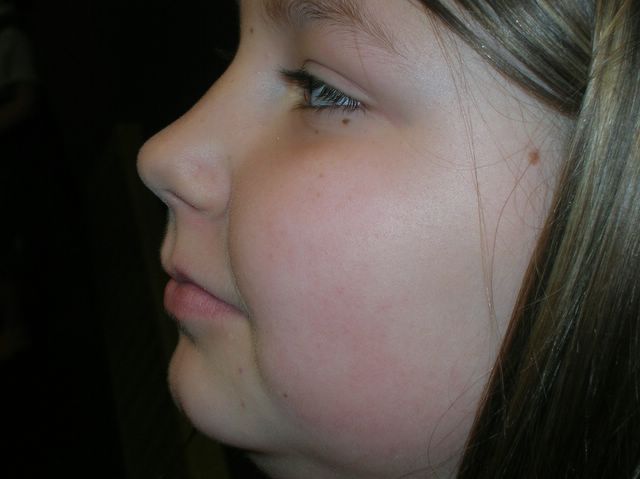
I love Penn and Teller’s Bullshit! show on Showtime. I found some old articles written by Penn at this website: http://www.pennandteller.com/sincity/penn-n-teller/pcc.html
I love old comics. Have I said that already? I found a website that has some really cool old ones, the ones that make science fiction and horror (and even some old romance comic books) fun. I found those here: http://www.sciencemonster.net/print/print.html Slow downloads though.
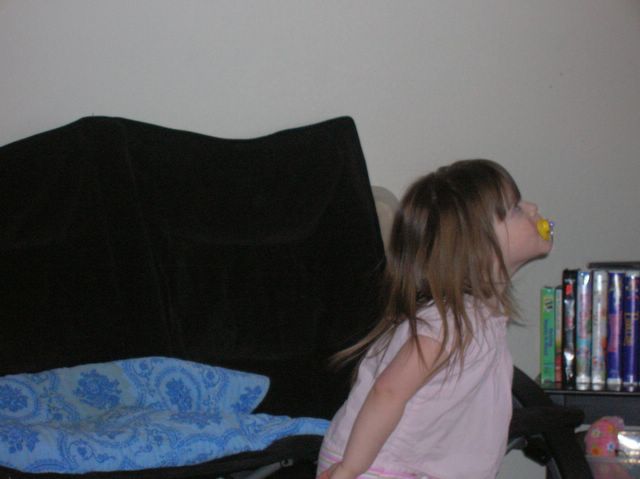
Speaking of science fiction, the future of sci-fi is cyberpunk. I found a cool collection of cyberpunk short stories here: http://project.cyberpunk.ru/lib/

More bad sci-fi novels can be found for free at the Baen free library. These are actual books and you can find them at the big book stores. http://www.baen.com/library/

I found old articles from Omni magazine here at http://www.findarticles.com/p/articles/mi_m1430 If you never read Omni magazine in the 80s or early 90s, you missed out on some weird science fact articles, UFO stuff to laugh at, and some great science fiction.

I just find it amazing what’s online if you really look. I didn’t even write in all the comics and books I found at http://www.projectw.org
posted by Matt Butcher @ 10:01 AM   0 comments
Thursday, February 02, 2006
Pins and Needles

Ralph Kramden once said, "Pins and needles, needles and pins. A happy man is a man who grins."

There are times when you have to just grin and go on.

Today my lesson failed miserably. Not because it was a bad lesson but because the seventh and eighth graders may not have been ready for it. We are doing some media literacy and looking at pictures and ads and what one person sees in the picture from another person. I just had one of the worst discussion days today. The concepts of deduction, inference, and connotation were way too high for them. I went in with high hopes. I did my best. I could see in their eyes they weren't getting it.

That's just one lesson though. They will be analyzing their own choice of advertisement in a paper next week. Hopefully, that will be a much better idea than to speak in generalities. We did look at the picture above and try to see what others might interpret. We tried.

It's all right. This is what you learn as a teacher the first time you teach a certain grade level. There are some concepts that they just aren't cognitively ready for and you only learn that by trying.

They are doing phenomenally well with their Shakespeare speech memorization though.
posted by Matt Butcher @ 6:44 PM   0 comments
Eskimo Heritage Reader part 4
Marriage on St. Lawrence Island

Marriages were planned by the parents and the elders of the tribe. The young man’s family came first to the girl’s family. Very respectfully, they offered ceremonial gifts. If the girl’s parents felt honored by these gifts, they would agree to the marriage. Then the young man came to work for the girl’s parents and for the rest of her tribe. For a year or more, he worked, running errands, carrying water, and helping everyone in the tribe. Only then was he entitled to marry the girl.
In our happy girlhood days, we just followed our parents’ advice. When we saw the gifts come to our house, we knew we were to be married. We did not know our husbands before that. It was hard to be a wife to someone you didn’t know. Girls were praised for bravely following their elders’ advice. Some opposed the choice, but that was considered shameful. Then their people were ashamed.
In time, the groom was allowed to stay in the girl’s home, but he was to sleep separately. After a few nights, he would lie down beside the girl as she slept. When she woke up, she would fight to get away. Night after night, this continued. Finally, her parents—usually her father—ordered her to stop and to accept her husband.
For the girl, this begins a great change in her life. She gets to know her husband. No more crying or fighting. The couple learns to love each other.
Finally the time comes for the young couple to move to the boy’s home. The girl’s parents are firm about this, especially when the boy has worked hard. It is difficult for some girls to leave home.
Estelle Oozevaseuk recalls: “It was very hard for me to face learning home. I had to learn to like it. My great-uncle Qiivun stayed at our house all day, helping me get ready to go. The people of my tribe brought gifts. They gave things of value: skins, rope, tools and so on, so our tribe would not be ashamed. It was the same way with the boy’s parents when the agreement was made. His tribe brought gifts to my family.
“But that day I was feeling bashful toward Qiivun. I thought he just wanted to get rid of me. I didn’t realize it was for my own good. My great-uncle gave me a tool, a large plane. As we left, he said, ‘When you get there, give this to Uziva, your father-in-law.’
“Soon, there came Anasuk, my husband’s aunt. She came as the representative of his family. With a start, I thought, ‘Here she comes. I’m being moved.’ So it is for every woman as she begins her new life as a wife and mother.
“So, like a little caravan, we went our way carrying gifts. It was customary to carry gifts while walking to your new home. A line of relatives from my tribe walked me over to my in-laws’ house. It was good that their house was not far from ours. People joined in happily. They were contributing to the happiness of this young couple There are too many discontented and unhappy marriages.
“I walked very bashfully up to my father-in-law Uziva and handed him the planning tool. Smiling, he took it. That was the start of my new life. From then on, I lived and moved with my husband’s family.”

By Flora Imergan, Estelle Oozevaseuk and Mabel Toolie
posted by Matt Butcher @ 4:29 PM   0 comments
Wednesday, February 01, 2006
Eskimo Heritage Reader part 3
A Bad Night

As a boy, I lived at reindeer camp with my family. During the summer, there wasn’t much to do upriver. And it got lonesome. So my family moved to the coast to hunt ducks and to fish for herring and tomcod. People then had to make a living by hunting and fishing. Finally, when there was no more ice, the herring came up to the beach. Everyone set their nets with boats and caught as many as they could. Then, all the women got busy cutting and storing herring. They did this so they would have plenty of dogfood in the winter.
One night when I was a boy, I remember the herring were jumping out of the sea and all over the beach. My friend Leslie and I stayed up that night playing. We decided to make a house, a small one out of driftwood. We split the wood, cut and shaped it like a house. We put on a door. We put grass on the floor. We took a coal-oil can, made it into a stove and burned wood in it. The stove was about 12 by 10 inches and would get really warm.
We felt good about our new house. The fire was going, and it was very warm. We put all our things in it—our clothes, blankets, grub. After watching the herring for awhile, we decided to go fishing. I got my father’s net. I told my friend, “Let’s set the net for herring with a kayak, my old man’s kayak.”
Now kayaks are not to take as you please. My dad would not want us to take his kayak. This was for our own good, so that we didn’t drown. But I wasn’t too good at listening, and I wanted to go fishing. Even though we were told not to, we pushed the kayak out. The tide was coming in. The fish were jumping. We were ready to set the net. We spread the net on the beach and got it all ready with the sinker and the floater separated.
Leslie was older. He told me, “You take care of the net on shore, and I’ll put out the anchor.”
I replied, “No, I’ll hold onto the net, and we’ll both get in the kayak back-to-back. Now you paddle while I hold the anchor. When the net straightens, I’ll throw out the anchor.”
He didn’t say anything for awhile. Finally, he agreed. I went in first and held on to the anchor. Out we went to straighten the net. But I held onto the anchor too long. It slid to my left, and our kayak tipped over.
The kayak was upside down. We were trapped under water. Both of us tried to get out at the same time, but we were stuck. We moved every which way. I was running out of air. I pressed hard against the kayak rim so Leslie could get out. He moved and got out. Then I got free also. I bumped the bottom hard with my head. I stood up. There was Leslie with the kayak between us. He smiled at me, so I smiled back at him.
Suddenly we saw that our house was on fire. The grass on the floor had caught fire from the stove. It was really burning! We pulled the kayak, full of water, up to the beach. We ran up to the house, but we couldn’t save it. Everything burned. We couldn’t do a thing.
So we went to the kayak and let the water out. We turned it upside down and cleaned it. Then we put it back where we got it. We folded up the net. We didn’t even get to set our net. We went back to where our house was. The sun was just coming up.
Leslie said, “My dad has a tarp we can sleep with. Let’s make a bed between two logs, and we can use it for a blanket.” I got the tarp. We built a fire, and we hung our clothes up to dry. Then we went to bed, and slept and slept…
My dad woke us up at 2:00 in the afternoon. “Don’t sleep too much. You have to eat.” We got up. We went to put on the clothes that we hung up. They should have dried by now. I looked for my pants. No pants. Only the poles were standing up. I looked and saw some ashes. I swished the ashes around and saw the bottom of my pants. I sure had bad luck that night!
My family’s tent was not too far away, across the tundra. I put on a shirt, underwear and boots. No pants. My pants had burned. My mother looked at me and asked, “Why don’t you have any pants on?”
“I was drying them, and they burned.”
She dug into the clothes sack and gave me a pair of pants. She didn’t scold me, even though she always scolds so hard. This time I needed scolding and I knew it.

By Wassilie Eakon of Unalakleet
posted by Matt Butcher @ 8:30 PM   0 comments
Eskimo Heritage Reader part 2
Eskimo Games from Gambell

These games came from long ago. As long as I can remember, these games have been a part of our life.

Hunting Games
In the winter when we were young, we played polar bear. The elders wanted us to learn how to kill a real polar bear, so we played this game. This is how the game was played.
Someone is the bear, and the others are hunters. First we chase the bear and tire him. When he is tired and panting, he acts dead. We look closely to see which way he turns, for some polar bear turn to the left and some turn to the right. Then we kill the bear with a lance, the way they killed them long ago. Next we pretend to cut him up. Hauling each other across the snow, we bring home our “game” and put it into a pit in the snow.
In this game, we dig deep into the snow and make houses, just like our sod houses. We make beds out of snow and add a shed to the doorway. A wick dipped in sealoil is our light. Outside, we make a polar bear head our of snow, with its jaws open just like a real polar bear.
In another game, we act like seals. We make small pits in the snow. Someone gets into the pit and acts like a seal or a walrus. We pretend to spear them. And they pretend to get loose from our spears. We played like this after school in the winter when the days grew longer.
Another winter game is called uvesqan. The uvesquat is made from the hipbone of a seal. On one side of the bone is a small hole. On the other side, a string is tied to another hole. A small pointed stick is tied to the end of the string. To play uvesqan, we hold the stick and swing the bone back and forth. Then we try to land the bone’s little hole right on the point of the stick.
In the spring we played a game with bollos. One bollo, flung into the sky, is a bird. We throw other bollos to try to catch it. In this way, we learn how to hunt real birds.

Ball Games
Then in the springtime, they start hunting whale and walrus. Many games are forbidden at this time, out of respect for the meat. Ball games especially are forbidden. Then when they finally catch a whale, the elders urge us, “Now you can play real ball games.” And we reply, “Okay!” We hurry back to our boats, knowing that tonight we will play a ball game. Quickly we mix the gas and lube for our outboards. Quickly we haul our gear up on the beach. For tonight a team from the north side of the village will play against a team from the south side.
To play aghqutan, there are two equal teams. Each team tries to kick the ball to its side. We can’t lay our hands on it, only kick it as we run. Those who are fast can really travel with the ball. It is a very tiring game, much like soccer.
Kalleghta is another ball game played after whaling. Here, the men play the women. We play down on the beach with a ball, they pass it back and forth, and we men have to get it back.

Inside Games
Here is another winter game, called kuvaghan. A time comes when there are plenty of crabs, and we gather up their claws. Sitting in a circle, we take a bundle of crab claws and drop them to the floor. Some of them land upside down. Some land standing up. We count the upright claws for our points.
Sometimes we make the crab claws “wrestle.” Two players each spin a claw to the floor. The player whose claw lands upright takes the other claw. Each one starts with his smallest piece and moves on to his largest. The one who has the most claws at the end wins. If we run out of crab claws, we use toy ravens to play this game.
Inside at night, we play a game like pick-up sticks. We slice wood into small sticks and file them into thin, smooth pieces. Then we take a bundle of sticks and drop them to the floor. They fall into a pile. We try to pull out as many sticks as we can, one by one, without moving any other sticks. If we move a stick, we lose our turn. Then someone else tries to pull out some sticks. Whoever has the most sticks is the winner.
Another indoor game is played with the hipbone of a seal. We all sit in a circle. Each player tries to break the bone in half. When the bone is broken, we cheer the person who broke it.
In the evenings, the girls take out their little carved toys and play house. They have toy stoves made of clay and skin-covered rooms. They pretend to light their little stoves. Their dolls have only the upper body. They have faces, but no arms. The toy women have breasts. There are also toy dogs, with a little harness and a sled.
We boys play apart from the girls. Our games are not like theirs. We let the toy dogsled mush. We make the dogs bark and woo. We take that little dogsled somewhere looking for game, just like in real life.

These are the games I remember from long ago. Some games can cause quarrels, if the players are short-tempered. The elders would scold us if there was any quarreling. We lived in obedience to the elders then. They wanted to play our games in harmony.

By Steven Aningayou of Gambell
posted by Matt Butcher @ 8:14 PM   0 comments

I walked the few hundred yards to work this morning and it was negative thirty degrees. That is 100 degrees colder than I keep my apartment. Some people have told me that this isn't normal. Others are shrugging and saying, "This is Nome."
posted by Matt Butcher @ 8:06 PM   0 comments
Independent Propaganda Entertainment EarthEntertainment Earth
Random thoughts about all that I can muster. As William Shatner once said, "Get a life!"
The Butcher Shop

Name: Matt Butcher
Home: Normal, IL, United States
About Me: An English teacher with a zest for life. Family. Comic books. Stuff.
See my complete profile
  • Subscribe

  • Previous Posts
    Archives
    Stuff

    Butcher Photo Album Free Ground Shipping on for orders over $69 at www.Tystoybox.com

    www.flickr.com
    This is a Flickr badge showing public photos from The Butcher Shopmjb0123. Make your own badge here.


    "This above all: To thine own self be true." --Shakespeare

    DEITY OF THE DAY!
    Featured today:
    (read more)
    www.godchecker.com


    "If it don't kill you, it only makes you stronger" --Nietzsche by way of Bruce Willis


    "I am not a number, I am a free man!"
    --Number Six


    "For tho' from out our bourne of Time and Place
    The flood may bear me far,
    I hope to see my Pilot face to face
    When I have crost the bar."
    --Tennyson


    "My name is Ozymandias, king of kings:
    Look on my works, ye mighty, and despair!"
    Nothing beside remains: round the decay
    Of that colossal wreck, boundless and bare,
    The lone and level sands stretch far away.
    --Shelley


    "Coffee should be black as hell, strong as death, and as sweet as love."
    --Turkish Proverb


    Tho' much is taken, much abides; and tho'
    We are not now that strength which in the old days
    Moved earth and heaven; that which we are, we are;
    One equal-temper of heroic hearts,
    Made weak by time and fate, but strong in will
    To strive, to seek, to find, and not to yield.
    --Tennyson

    Links
    Powered by

    This page is powered by Blogger. Isn't yours?
    Ka-Blam Print-On-Demand Creative Commons License
    This work is licensed under a Creative Commons License.

    Quote of the Day

    BLOGGER